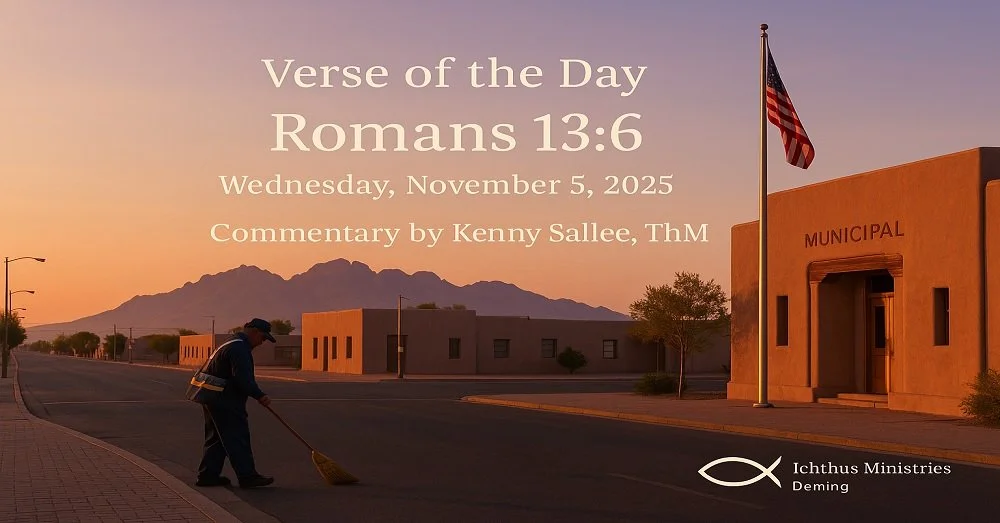
Verse of the Day
Wednesday, November 5, 2025
Romans 13:6
For the same reason you also pay taxes, for the authorities are God’s servants, busy with this very thing.
Introduction
Romans 13:6 stands within the Apostle Paul’s broader discourse on the believer’s relationship to governing authorities (Romans 13:1–7). This passage, often cited in discussions of Christian civic duty, expresses a profound theological assertion: civil authority, though secular in function, operates under divine appointment. In this verse, Paul connects the practical act of paying taxes with the spiritual reality of submission to God’s order. The verse underscores that obedience to civil structures—when exercised justly—forms part of a Christian’s moral and spiritual responsibility, carried out “for conscience’s sake” (Romans 13:5). In Paul’s theology, honoring lawful governance becomes an expression of faithfulness to God’s sovereignty rather than mere compliance with human law.
Commentary
The phrase “For the same reason” (Greek: διὰ τοῦτο γὰρ, dia touto gar) connects this verse to the preceding argument: believers submit to authorities not only to avoid punishment but also because such submission aligns with a divinely ordered conscience. Paul transitions from principle to practice—if government officials serve God’s purposes, then financial support of their function becomes a moral obligation.
“You also pay taxes” (φόρους τελεῖτε, phorous teleite) is both descriptive and prescriptive. The verb teleite means “you pay” or “you render,” the same root used by Jesus in Matthew 22:21—“Render to Caesar the things that are Caesar’s, and to God the things that are God’s.” Paul implies that taxation, while administrative in nature, has a sacred dimension when seen as part of God’s providential order.
“For the authorities are God’s servants” introduces the Greek term λειτουργοί (leitourgoi), literally “ministers” or “those who perform public service.” In classical Greek and the Septuagint, leitourgos described those who served in sacred or civic functions, including priests in temple service (cf. Hebrews 8:2). By using this term, Paul sanctifies civic duty—asserting that rulers, whether aware of it or not, serve as agents within God’s governance of the world.
“Busy with this very thing” (εἰς αὐτὸ τοῦτο προσκαρτεροῦντες, eis auto touto proskarterountes) implies persistent, devoted service. Civil authorities dedicate themselves to maintaining societal order and justice—tasks which, in Paul’s view, align with divine purposes. Thus, paying taxes sustains the very structures through which God’s order is mediated on earth.
Understanding the Context
Paul wrote to the Christian community in Rome during the reign of Emperor Nero, a complex political environment characterized by heavy taxation and suspicion toward new religious movements. Early Christians, still forming their identity apart from Judaism, faced the delicate task of balancing allegiance to Christ with lawful submission to the Roman state.
Unlike revolutionary zealots in Judea who resisted Rome’s authority, Paul counseled believers to recognize that government, despite its imperfections, serves as part of God’s providential structure (Romans 13:1–2). His teaching does not endorse blind obedience but situates civic participation within a framework of divine sovereignty.
For Roman Christians, this meant paying taxes—even to a pagan government—was not capitulation but conscientious participation in the maintenance of social order. Paul’s message would have carried both reassurance and challenge: reassurance that submission to authority did not betray God’s kingdom, and challenge to resist rebellion born of pride or resentment.
Application for Today
In a modern context, Romans 13:6 continues to provoke reflection on the tension between faith and civic responsibility. Paying taxes, voting, obeying laws, and contributing to the common good are not merely civic acts—they are moral expressions of stewardship and integrity. When believers fulfill their obligations honestly and conscientiously, they affirm God’s providence over human institutions.
Yet Paul’s principle also demands discernment. Christians are called to support governance that promotes justice and peace (cf. 1 Peter 2:13–17), while maintaining prophetic witness against corruption, oppression, or idolatry of the state. The believer’s loyalty to Christ remains paramount; however, this loyalty often manifests through responsible engagement rather than withdrawal.
In a world prone to cynicism toward government and public institutions, Paul’s instruction reminds the faithful that civic duty—when exercised in truth and fairness—is a form of worship. The paying of taxes, viewed through a theological lens, becomes not an act of compulsion but an offering of conscience within God’s order.
Reflection
Romans 13:6 invites believers to see the ordinary act of paying taxes as a reflection of divine order and moral coherence. Paul challenges us to approach civic responsibility with a heart aligned to God’s will rather than resentment or apathy. Faith does not withdraw from public life—it sanctifies it.
When Christians live as honest stewards within their societies, they testify that God’s sovereignty extends beyond the walls of the church and into the marketplace, the courthouse, and the public square. This verse compels each believer to examine the motives behind obedience—whether it is driven by fear of penalty or guided by reverence for God’s authority. In doing so, Paul lifts a mundane civic obligation into the realm of sacred duty, reminding us that conscience, integrity, and faithfulness must accompany every act of submission in the life of a disciple.
The Bible texts are from the New Revised Standard Version (NRSV) Bible, copyright © 1989, 1993 the Division of Christian Education of the National Council of the Churches of Christ in the United States of America. Used by permission. All rights reserved. Verse of the Day is a daily inspirational and encouraging Bible verse, extracted from BibleGateway.com. Commentary by Kenny Sallee, ThM.
