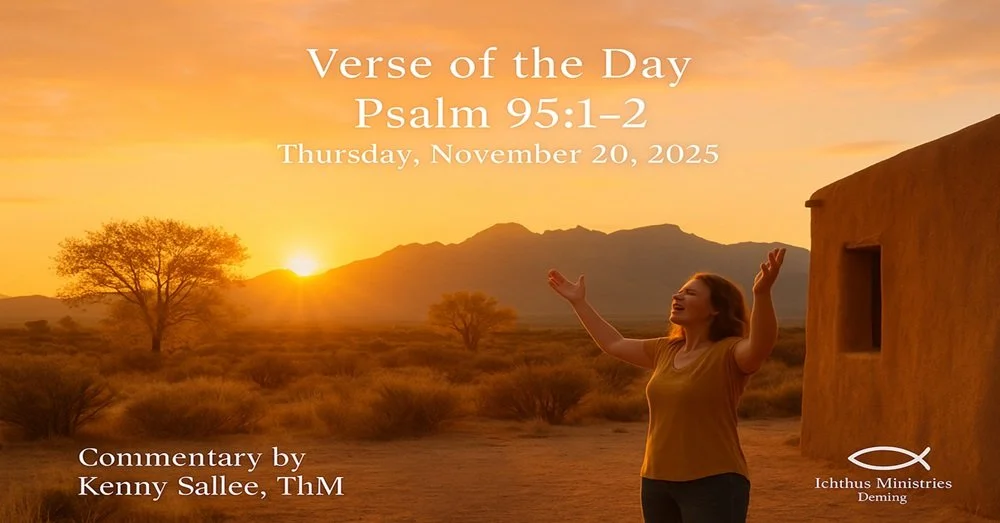
Verse of the Day
Thursday, November 20, 2025
Psalm 95:1-2
O come, let us sing to the Lord; let us make a joyful noise to the rock of our salvation! Let us come into his presence with thanksgiving; let us make a joyful noise to him with songs of praise!
Introduction
Psalm 95 opens with an exuberant invitation to worship—a summons not to a passive acknowledgment of God but to an active, joyful participation in His praise. As one of the enthronement psalms, it celebrates the Lord as Creator, Sustainer, and Shepherd of His people. The psalm calls the faithful to respond to God’s majesty and mercy with heartfelt joy, uniting the whole community in thanksgiving. Positioned near the beginning of Book IV of the Psalter (Psalms 90–106), it serves as a corrective to despair and exile, re-centering the believer’s heart on the sovereignty and steadfast love of God. Psalm 95 thus stands as both a liturgical call to worship and a theological reminder that gratitude and reverence are inseparable in the life of faith.
Commentary
Verse 1: “Oh come, let us sing to the Lord; let us make a joyful noise to the rock of our salvation!”
The psalm begins with a communal invitation—“come”—a word of fellowship and gathering. Worship is not solitary here; it is the joyful chorus of a people united in faith. The phrase “make a joyful noise” (Hebrew ruaʿ) conveys not mere volume but the exuberant shout of victory or acclamation offered to a king. This echoes Israel’s practice of shouting in triumph when the Lord delivered them from enemies (cf. Joshua 6:5). The title “the rock of our salvation” draws on imagery of stability and refuge. In a desert landscape where rocks symbolized shelter and strength, the metaphor points to God as the unchanging foundation of deliverance and hope.
Verse 2: “Let us come into his presence with thanksgiving; let us make a joyful noise to him with songs of praise!”
The psalmist deepens the invitation—worship involves approach. “Coming into His presence” evokes the temple setting where worshippers entered the courts of the Lord with offerings and thanksgiving (cf. Psalm 100:4). The word “thanksgiving” (todah) implies both gratitude and confession, suggesting that praise flows naturally from acknowledging God’s goodness. The repetition of “joyful noise” reinforces that worship is an outpouring of delight rather than duty. “Songs of praise” (zimrah) implies music accompanied by instruments—an embodied, celebratory response that engages heart, voice, and hand alike.
Understanding the Context
Psalm 95 likely emerged within the context of Israel’s temple worship, where corporate singing and thanksgiving marked the rhythm of the nation’s spiritual life. The psalm’s exuberant opening contrasts with its later warning against hardening one’s heart (vv. 8–11), forming a liturgical arc that moves from praise to obedience. Historically, it reflects Israel’s covenant relationship—God as the faithful deliverer and Israel as the grateful people. Canonically, this psalm has long served as the invitatory psalm in both Jewish and Christian liturgies, calling the faithful to worship at the start of daily prayer (notably in the Roman Catholic Liturgy of the Hours and the Anglican Morning Office). Its recurring use emphasizes that every act of worship begins not with human merit but with divine invitation—a reminder that joy and reverence coexist at the threshold of God’s presence.
Application for Today
In a world often marked by hurry and distraction, Psalm 95:1–2 invites believers to rediscover the sacred rhythm of praise. Singing to the Lord is not limited to music but encompasses every expression of gratitude and joy that acknowledges His faithfulness. Modern worship can easily drift toward performance or habit, yet this psalm calls us to approach God with sincerity and thanksgiving. Whether through song in a congregation, gratitude whispered in solitude, or simple acts of kindness offered in Christ’s name, believers embody this psalm’s message by turning their attention from self to the steadfast Rock who sustains them. The psalm encourages communities of faith to cultivate spaces where worship unites rather than divides—where every voice, regardless of skill, becomes part of the joyful noise of redemption.
Reflection
Psalm 95:1–2 reminds us that worship begins not with obligation but with invitation. It is an awakening of the soul to the reality of God’s enduring goodness. True praise arises when gratitude outweighs complaint, when remembrance of deliverance outweighs fear, and when hearts find their rest upon the Rock of salvation. In singing, thanking, and rejoicing, we are reshaped—drawn out of isolation and into communion with the One who anchors us. Joyful worship, then, is not mere expression; it is formation. It renews the heart, deepens faith, and turns every ordinary moment into a sanctuary of thanksgiving.
The Bible texts are from the New Revised Standard Version (NRSV) Bible, copyright © 1989, 1993 the Division of Christian Education of the National Council of the Churches of Christ in the United States of America. Used by permission. All rights reserved. Verse of the Day is a daily inspirational and encouraging Bible verse, extracted from BibleGateway.com. Commentary by Kenny Sallee, ThM.
