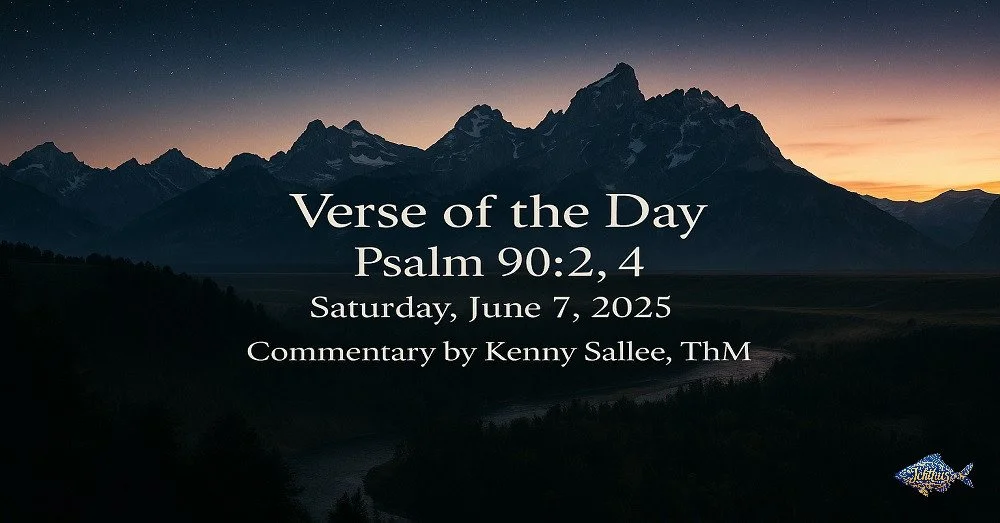
Verse of the Day
Saturday, June 7, 2025
Psalm 90:2, 4
Before the mountains were brought forth, or ever you had formed the earth and the world, from everlasting to everlasting you are God. For a thousand years in your sight are like yesterday when it is past, or like a watch in the night.
Introduction
Psalm 90 stands as a sobering and profound reflection on the nature of God and the fleeting condition of humanity. Traditionally attributed to Moses, this psalm contrasts the eternal and unchanging character of God with the frailty and brevity of human life. Verses 2 and 4 underscore the mystery of God’s timeless existence and offer a glimpse into how differently He views time compared to mankind. These verses remind readers of the majesty of God who reigns from everlasting to everlasting, unbound by the limits that define human existence.
Commentary
Verse 2 paints a majestic portrait of God as the Creator who existed before the very foundations of the world were laid. The poetic image of “before the mountains were brought forth” draws from the grandeur and permanence of nature, yet even these vast, ancient formations are fleeting compared to God’s eternal being. The phrase “from everlasting to everlasting” captures a divine existence without beginning or end—an infinite span that wraps around the whole of time.
Verse 4 deepens this theme by illustrating how human measurements of time are meaningless to God. “A thousand years… like yesterday… or like a watch in the night” compresses vast spans of human history into fleeting moments from God’s vantage point. The metaphor of a “watch in the night”—a brief period during which a guard would keep watch—emphasizes how temporal concerns are but brief flashes in divine reckoning. Together, these verses speak of God’s complete transcendence over time and His perspective that surpasses all human understanding.
Understanding the Context
Psalm 90 is uniquely attributed to Moses, making it the oldest psalm by authorship and deeply resonant with Israel’s wilderness journey. As the people wandered through the desert, faced with the consequences of disobedience and the need for divine mercy, Moses offered this prayerful reflection. It speaks to a generation grappling with mortality, repentance, and the hope of divine favor.
Placed at the beginning of Book IV of the Psalter (Psalms 90–106), this psalm marks a pivotal shift. Book III ends in lament over the fall of the Davidic kingdom (Psalm 89), and Psalm 90 begins anew with a focus on God's eternal rule rather than earthly kingship. This sets a new theological tone—one that leans more on God’s unchanging nature than on human leaders or institutions.
Application for Today
In a world filled with change, uncertainty, and the pressure of limited time, Psalm 90:2, 4 provides grounding reassurance. The eternal nature of God serves as an anchor amid the rapid pace of modern life. While we often feel overwhelmed by the passing of time or anxious about the future, these verses remind us that God is not only present through it all—He stands above it, unshaken and sovereign.
Believers can draw comfort knowing that God’s promises are not tied to the fluctuating moments of our lives but are rooted in His everlasting faithfulness. Trusting in a timeless God invites us to release the burdens of our schedules and the fear of running out of time. It encourages us to live with deeper purpose, knowing that our lives find meaning within His eternal plan.
Reflection
How often do we live as if time is our enemy—rushing from task to task, worried about the legacy we will leave behind? Psalm 90 invites us to pause and ask: How might our lives change if we viewed our days through the lens of eternity? Would we prioritize differently, love more deeply, or live more generously?
Take a moment to reflect or journal on this question: *What does it mean for me to live with “eternity in view”?* You might choose to pray the following words:
Prayer
Eternal God, from before the first sunrise to long after the last star fades, You remain. Teach me to number my days rightly, not in fear but in faith, so I may live wisely and well. Anchor me in Your everlasting presence and guide me to trust in what is eternal, not what is passing. Amen.
The Bible texts are from the New Revised Standard Version (NRSV) Bible, copyright © 1989, 1993 the Division of Christian Education of the National Council of the Churches of Christ in the United States of America. Used by permission. All rights reserved. Verse of the Day is a daily inspirational and encouraging Bible verse extracted from BibleGateway.com. Commentary by Kenny Sallee, ThM.
