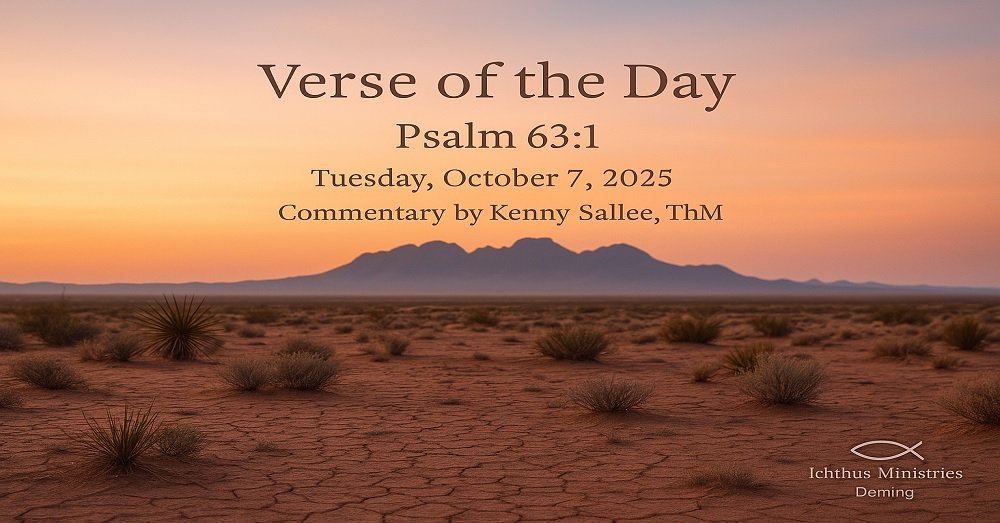
Verse of the Day
Tuesday, October 7, 2025
Psalm 63:1
O God, you are my God, I seek you, my soul thirsts for you; my flesh faints for you, as in a dry and weary land where there is no water.
Introduction
Psalm 63:1 opens with one of the most poignant expressions of longing for God in all of Scripture: “O God, you are my God, I seek you, my soul thirsts for you; my flesh faints for you, as in a dry and weary land where there is no water.” This verse captures the deep yearning of the human heart for communion with the Divine, using images of thirst, faintness, and barrenness to express the intensity of spiritual desire. It sets the tone for the psalm as a whole, which moves from desperate longing to confident praise, revealing the believer’s unshakable trust in God even amid desolation.
Commentary
The verse begins with a declaration of covenantal intimacy: “O God, you are my God.” The repetition emphasizes not only ownership but belonging—God is not distant but personal, one who is sought after and clung to. The psalmist continues: “I seek you.” The Hebrew verb here suggests more than casual searching; it conveys earnest pursuit, the deliberate action of one who rises early with determination to find what is most essential.
The imagery of “my soul thirsts for you” deepens the metaphor. Thirst is not optional but a basic need for life, underscoring that relationship with God is not merely desirable but necessary for survival. The parallel expression, “my flesh faints for you,” reinforces this urgency by tying the longing for God to the whole person—body and spirit. Finally, the comparison “as in a dry and weary land where there is no water” anchors the psalm in a landscape of scarcity, painting a vivid picture of desperation where only God can provide refreshment.
Understanding the Context
Psalm 63 is traditionally attributed to David, composed “when he was in the wilderness of Judah” (superscription). This wilderness setting gives the imagery of thirst and dryness an immediate, literal force. In the arid deserts of ancient Israel, water was precious and often scarce, and the physical experience of thirst would have been acute. For David—or any psalmist in exile—the barren wilderness symbolized not only physical hardship but also spiritual trial, testing trust in God’s sustaining presence.
The psalm belongs to Israel’s tradition of individual laments and hymns of trust. It reflects the covenant faith of Israel, where longing for God is rooted in His past acts of deliverance and His abiding presence with His people. In worship, this psalm would have reminded the community that even in the harshest conditions, God remains the source of life, satisfaction, and hope.
Application for Today
For modern readers, Psalm 63:1 speaks powerfully into the realities of spiritual dryness and longing. Many today experience seasons where God feels distant, where prayers seem unanswered, or where the soul feels barren and empty. The psalm reminds us that such thirst is not a sign of failure but a sign of life: only living souls thirst for God.
The imagery of the body fainting for God also challenges a fragmented spirituality. It affirms that our faith involves the whole person—our emotions, physical energy, and daily practices. Just as thirst drives us to seek water, spiritual hunger should drive us to pursue God through prayer, Scripture, worship, and community. In a world that often distracts with substitutes for satisfaction, this psalm calls us back to the only source who truly quenches our deepest needs.
Reflection
Psalm 63:1 captures the essence of authentic faith: it is not merely intellectual assent but a deep, embodied yearning for God’s presence. The verse reminds us that longing for God is both natural and necessary, as essential as water in a desert. It also teaches that times of dryness are not devoid of meaning but can sharpen our awareness of dependence on God. In the wilderness, the psalmist finds not despair but a greater urgency to cling to the One who sustains life.
Ultimately, this psalm calls us to recognize our thirst, not to deny it or numb it, but to let it drive us to the God who alone satisfies. In doing so, the believer discovers that the desert of longing can become a place of profound encounter, where God’s sustaining presence is more deeply known.
The Bible texts are from the New Revised Standard Version (NRSV) Bible, copyright © 1989, 1993 the Division of Christian Education of the National Council of the Churches of Christ in the United States of America. Used by permission. All rights reserved. Verse of the Day is a daily inspirational and encouraging Bible verse, extracted from BibleGateway.com. Commentary by Kenny Sallee, ThM.
