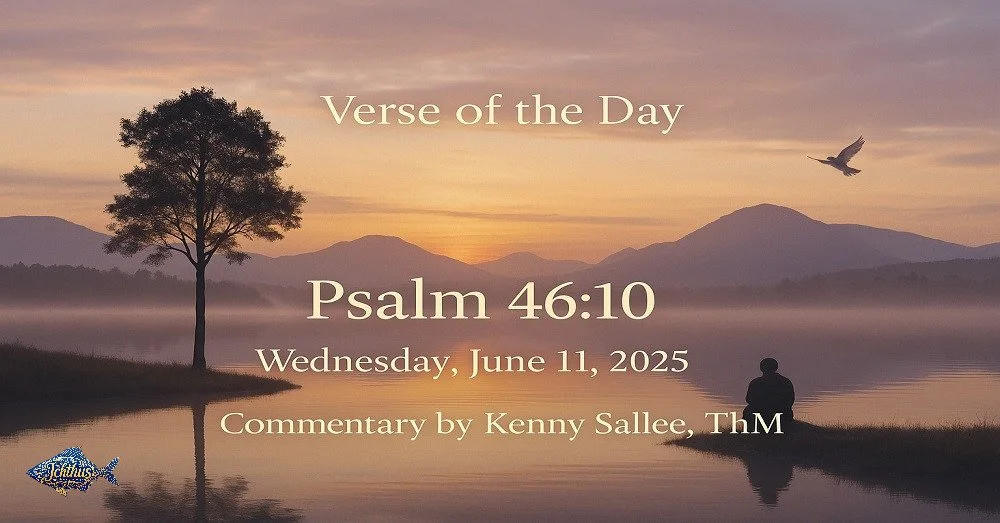
Verse of the Day
Wednesday, June 11, 2025
Psalm 46:10
Be still, and know that I am God! I am exalted among the nations, I am exalted in the earth.
Introduction
Psalm 46:10 stands as one of the most beloved and quoted verses in Scripture—a divine summons to quietness and deep trust in the midst of life’s storms. Its simplicity belies its profound spiritual depth. In a world driven by noise, activity, and uncertainty, these words come like a whispered command from the heart of God: “Be still, and know that I am God.” It’s not merely a comfort but a call to surrender. This verse has endured across generations, anchoring both personal devotion and communal worship in the unshakable reality of God’s presence and sovereignty.
Commentary
“Be still”: The Hebrew phrase harpu (translated “be still”) literally means “let go” or “cease striving.” It is not merely physical stillness, but an inner surrender—a release of panic, effort, and self-reliance. The phrase calls for a deliberate pause, a relinquishment of control in the face of divine sovereignty.
NIV translates this as “Be still.”
KJV similarly renders it “Be still,” but other interpretations suggest “Cease your fighting” (CSB), emphasizing an end to conflict—both external and internal.
“and know that I am God”: The word yada in Hebrew means more than intellectual knowledge; it implies intimate, experiential understanding. To “know” that God is God is to recognize His power, faithfulness, and presence in both the highs and lows of life. It calls for a deep-rooted trust that transcends mere belief.
“I am exalted among the nations”: This phrase shifts the focus from the individual to the global scope of God's reign. God's supremacy is not confined to Israel or the Church; He is Lord of all peoples and cultures. His exaltation will be recognized by every nation, as foretold in prophetic and eschatological texts (cf. Philippians 2:10–11).
“I am exalted in the earth”: A parallel declaration reinforcing the universality of God's dominion. The repetition underlines that God's glory is not dependent on human recognition—He is exalted. It points forward to the consummation of God’s kingdom, where His glory fills the earth (Habakkuk 2:14).
Understanding the Context
Psalm 46 is attributed to the sons of Korah, a Levitical family charged with temple worship and music. The psalm was likely composed during a time of national crisis—possibly during Assyrian invasions or other political turmoil.
The psalm is structured in three stanzas, separated by the musical pause Selah, and it moves through:
Verses 1–3: Declaring God as a refuge amidst natural chaos.
Verses 4–7: God’s presence in the city of God (often seen as Jerusalem or Zion).
Verses 8–11: A call to behold God's sovereign works and power.
Verse 10 functions as a turning point. After describing upheaval—nations in uproar, kingdoms falling—God speaks directly. It’s the only verse in the psalm voiced by God Himself. His command pierces the turmoil: “Be still, and know…” It is both a divine rebuke to the restless and a pastoral comfort to the faithful.
Application for Today
In a culture plagued by anxiety, busyness, and information overload, Psalm 46:10 is radically countercultural. To “be still” is not passive withdrawal but spiritual resistance against the tyranny of noise and fear.
Practical applications include:
Practicing silence and solitude in daily devotions. Turning off devices, closing the door, and listening for God’s voice.
Letting go of outcomes, especially in uncertain situations. Releasing our grip on control allows us to trust that God is at work even when we are not.
Re-centering on God’s sovereignty, especially when global or personal events feel overwhelming. Whether in prayer, journaling, or meditating on Scripture, we can affirm: “You are exalted in the earth, not I.”
By cultivating stillness, we not only renew our spiritual life but become witnesses to a frantic world that needs to see peace that surpasses understanding.
Reflection
Psalm 46:10 is not a gentle suggestion—it is a command. And yet, it’s one spoken in love. In seasons of chaos, heartbreak, or restlessness, God’s voice does not shout above the noise; it invites us into stillness. There, in the quiet, we remember that the world does not rest on our shoulders—it rests in the hands of the Almighty.
The Bible texts are from the New Revised Standard Version (NRSV) Bible, copyright © 1989, 1993 the Division of Christian Education of the National Council of the Churches of Christ in the United States of America. Used by permission. All rights reserved. Verse of the Day is a daily inspirational and encouraging Bible verse extracted from BibleGateway.com. Commentary by Kenny Sallee, ThM.
