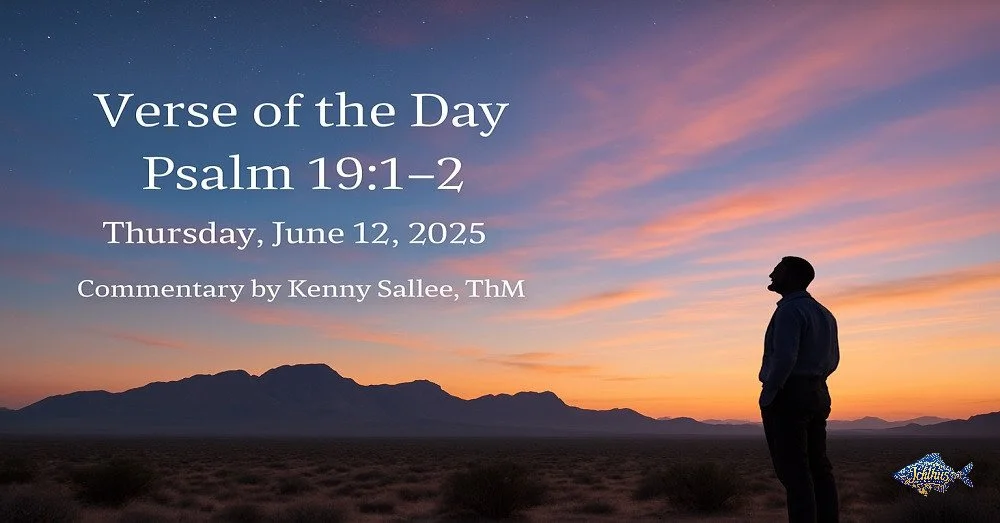
Verse of the Day
Thursday, June 12, 2025
Psalm 19:1-2
The heavens are telling the glory of God; and the firmament proclaims his handiwork. Day to day pours forth speech, and night to night declares knowledge.
Introduction
In a world saturated with noise and distraction, the quiet grandeur of creation continues to speak. Psalm 19 opens with a reminder that long before humans penned hymns or preached sermons, the natural world was already proclaiming God's glory. The skies themselves become a sanctuary, and each day and night a liturgy of wonder. This psalm draws our gaze upward and outward, inviting us to recognize the divine fingerprints across the canvas of creation.
Commentary
Verse 1: “The heavens are telling the glory of God; and the firmament proclaims his handiwork.”
The Hebrew word for “telling” (מְסַפְּרִים, mesaprim) implies an ongoing proclamation—an unceasing testimony. The “heavens” and “firmament” (or expanse) refer to the sky above, encompassing stars, clouds, sun, and moon. These visible realms become God’s heralds, declaring His glory not in words, but in beauty, order, and majesty. The term “handiwork” points to craftsmanship—what is seen in creation is the work of a divine artisan.
Verse 2: “Day to day pours forth speech, and night to night declares knowledge.”
Here the psalmist poetically illustrates how each day and night participates in this divine testimony. “Pours forth speech” suggests an overflowing fountain, emphasizing abundance and continuity. While this “speech” is not verbal, it is rich with knowledge—accessible to all who take time to see and listen. Nature is not silent; it speaks of the Creator through rhythm, light, darkness, and time.
Understanding the Context
Psalm 19, attributed to King David, is a deeply contemplative and theologically rich composition. It can be viewed in two parts: verses 1–6 celebrate God’s self-revelation through creation, and verses 7–14 shift to God’s revelation through the Law (Torah). This structure reflects a key biblical theme: God makes Himself known not only through Scripture but also through the natural world. Ancient Israel would have been attuned to the cycles of time, harvest, and celestial order, seeing them as evidence of divine governance. David captures this with poetic precision, blending the majesty of nature with the intimacy of faith.
Application for Today
In an age of artificial light and digital distractions, many of us have lost the habit of looking up. Psalm 19 invites us to return our attention to the heavens—not to worship them, but to perceive the Creator behind them. Sunrises, stars, seasons, and even storms can become opportunities for awe and spiritual awareness. This psalm calls us not only to worship but to steward creation, recognizing it as a sacred witness to God’s glory. In a time of ecological crisis, perhaps part of our faithful response is to protect the very creation that proclaims the Creator.
Reflection
Lord of all creation, help me to slow down, to look up, and to listen. When I see the stars wheel overhead or feel the warmth of morning light, let me hear Your silent speech and know that I am not alone. May I honor Your handiwork not just with praise, but with reverence in how I live upon this earth You’ve formed. Today, may I proclaim Your glory in my words and in my silence, joining the heavens in their eternal song. Amen.
The Bible texts are from the New Revised Standard Version (NRSV) Bible, copyright © 1989, 1993 the Division of Christian Education of the National Council of the Churches of Christ in the United States of America. Used by permission. All rights reserved. Verse of the Day is a daily inspirational and encouraging Bible verse extracted from BibleGateway.com. Commentary by Kenny Sallee, ThM.
