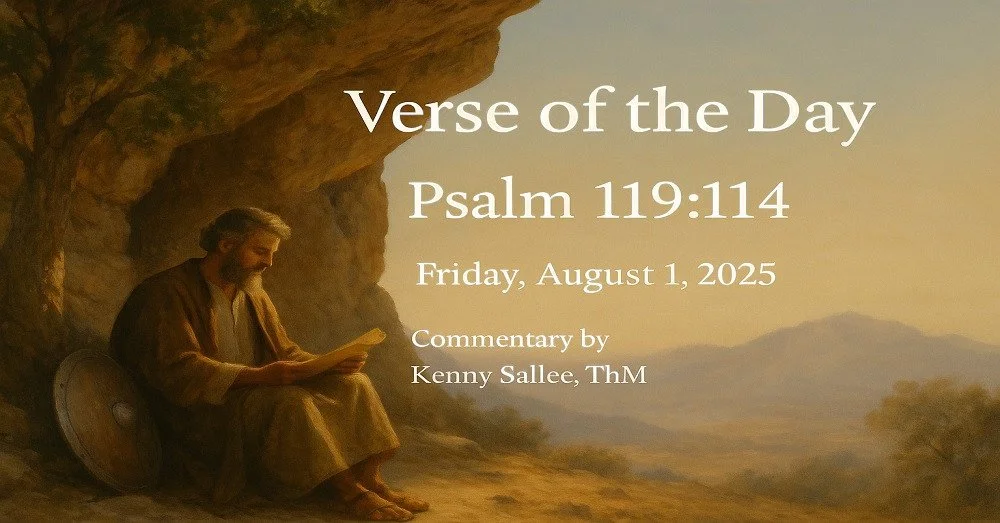
Verse of the Day
Friday, August 1, 2025
Psalm 119:114
You are my hiding place and my shield; I hope in your word.
Introduction
Psalm 119 is the longest chapter in the Bible, composed as an intricately structured acrostic poem, with each stanza corresponding to a letter of the Hebrew alphabet. More than a literary feat, it is a deep devotional meditation on the beauty, necessity, and sustaining power of God’s Word. Every verse exalts the life-giving authority of Scripture and the psalmist’s unwavering dependence upon it. In verse 114, found within the samekh stanza (vv. 113–120), we encounter a striking declaration of trust: “You are my hiding place and my shield; I hope in your word.” This verse serves as both a testimony and a vow, grounding spiritual security not in circumstances but in God’s faithfulness as revealed through His Word.
Commentary
The verse opens with two rich metaphors: “hiding place” and “shield.” In the Hebrew Bible, a hiding place (sēter) often denotes a secret shelter, a place of protection from enemies or calamity (cf. Psalm 32:7). It evokes intimacy and safety—God is not merely a distant guardian but a refuge one can draw near to in times of fear or uncertainty. The second image, “shield” (māgēn), is a common biblical symbol of defense, especially in warfare. Together, these metaphors convey both passive and active dimensions of God’s protection—He shelters and He defends.
The clause “I hope in your word” (dāḇār) ties these images to a concrete source: the promises of God. The Hebrew word dāḇār encompasses more than speech; it refers to the totality of God’s revelation—His covenantal truth, commandments, and faithfulness. Hope (yaḥal) in this context is not wishful thinking but confident, patient trust grounded in what God has said and done. The psalmist is not simply drawing comfort from abstract ideas; his hope is anchored in God’s self-revelation.
Psalm 119 repeatedly intertwines emotional and theological depth through poetic devices such as parallelism and metaphor. In verse 114, the structure forms a chiastic relationship: God (A) is my refuge and shield (B); I hope (B') in your word (A'). This reinforces the connection between who God is and what He has spoken, inviting the reader to trust fully in both His character and His covenant.
Understanding the Context
Verse 114 is situated in the samekh stanza (vv. 113–120), which is marked by a contrast between the double-minded and the devoted. Verse 113 declares, “I hate the double-minded, but I love your law,” establishing a clear moral and spiritual polarity. The psalmist is under pressure—perhaps from enemies (v.115) or internal fear (v.120)—and his confession of hope (v.114) becomes a stabilizing response to this tension.
Within this section, God’s Word becomes both shield and sanctuary for the faithful amid danger and duplicity. The psalmist expresses a desire to remain rooted in God’s statutes while distancing himself from those who are unreliable or unfaithful. Verse 114 acts as a personal creed that affirms: despite threats, confusion, or moral decay, God’s Word is the trustworthy place to rest one’s hope.
This passage anticipates the tone of verse 120, “My flesh trembles for fear of you, and I am afraid of your judgments,” underscoring the awe-inspiring seriousness of God’s justice. In light of this reverent fear, verse 114 offers not escapism, but a determined declaration that God's promises are the believer’s only safe haven.
Application for Today
In a world marked by uncertainty, misinformation, and shifting moral standards, Psalm 119:114 speaks with renewed relevance. Christians today face a multitude of pressures—cultural, ethical, and spiritual. There is a deep hunger for something unshakeable. This verse affirms that God’s Word provides both the refuge we need for our wounded souls and the defense we require against spiritual assault.
Finding God as a "hiding place" may involve intentional practices of quiet meditation, prayer, and reflection—carving out moments to be still and re-center on His truth. Seeing Him as our "shield" invites believers to stand firm against temptation, fear, and discouragement by arming themselves with Scripture (cf. Ephesians 6:16–17). Memorization of key passages, regular engagement with the Word, and participation in a community that upholds biblical teaching are practical disciplines that help make this verse a lived reality.
In times when headlines overwhelm and anxiety presses in, turning to the promises of God can restore hope and renew perspective. His Word is not only ancient truth but present help.
Reflection
Psalm 119:114 reminds us that the security we crave is not found in wealth, politics, or even personal strength—it is found in God’s steadfast presence and His unchanging Word. To say “You are my hiding place and my shield” is to admit vulnerability while proclaiming faith. It’s an act of defiant trust in the middle of life’s battles and uncertainties.
The psalmist models for us a posture of resilience—not because of self-reliance, but because of reliance on God’s Word. In that Word, we find a place to rest, to heal, and to stand firm. When the world around us feels chaotic, and when inner doubts stir, this verse becomes a quiet anthem for the soul: God is near, and His promises still hold.
The Bible texts are from the New Revised Standard Version (NRSV) Bible, copyright © 1989, 1993 the Division of Christian Education of the National Council of the Churches of Christ in the United States of America. Used by permission. All rights reserved. Verse of the Day is a daily inspirational and encouraging Bible verse, extracted from BibleGateway.com. Commentary by Kenny Sallee, ThM.
