Verse of the Day
Sunday, January 11, 2026
Psalm 118:5-6
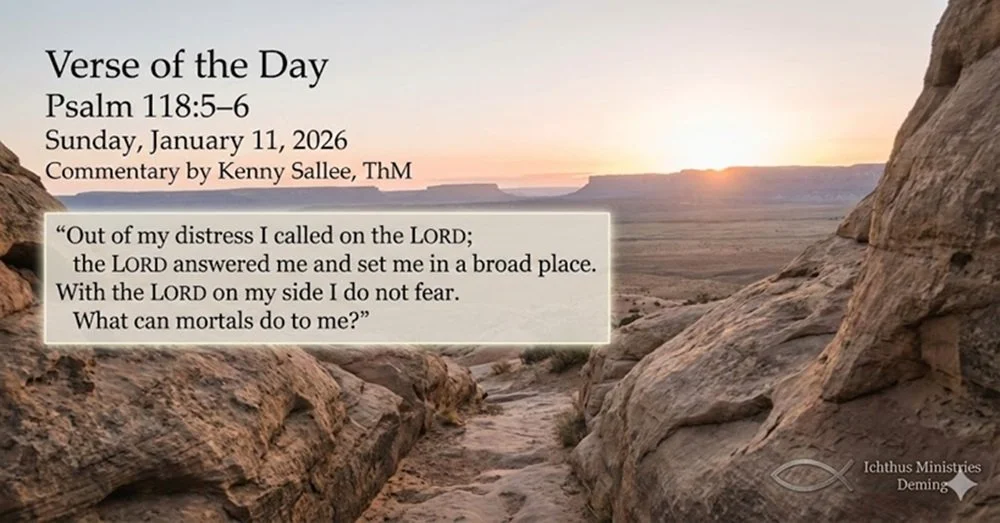
Out of my distress I called on the LORD; the LORD answered me and set me in a broad place. With the LORD on my side I do not fear. What can mortals do to me?
Introduction
Psalm 118 is a song of thanksgiving shaped by lived experience—an affirmation of trust born not from ease, but from deliverance. Positioned near the center of the psalm, verses 5–6 offer a personal testimony that reflects the broader communal praise unfolding around it. The psalmist speaks as one who has known pressure, fear, and confinement, yet who now stands in confidence because the Lord has acted.
These verses trace a clear movement: from distress to response, from fear to assurance. They do not deny the reality of danger or opposition; instead, they testify to the Lord’s presence within it. As such, Psalm 118:5–6 functions as a hinge between memory and hope—grounding praise in the conviction that the God who has delivered in the past remains trustworthy in the present.
Commentary
Psalm 118:5 begins with an honest acknowledgment of distress: “Out of my distress I called on the Lord.” The Hebrew image behind “distress” suggests constriction or confinement—a sense of being hemmed in with no apparent way forward. The psalmist’s response to this condition is not self-reliance or despair, but invocation. The act of calling upon the Lord signals trust even before deliverance is visible.
The second half of the verse introduces a striking reversal: “the Lord answered me and set me in a broad place.” The contrast between confinement and spaciousness is central. God’s answer is not merely verbal reassurance; it is experiential liberation. The “broad place” symbolizes freedom, security, and renewed possibility—life no longer dominated by threat.
Verse 6 moves from testimony to confession: “The Lord is on my side; I will not fear.” The psalmist’s confidence flows directly from divine presence, not from changed circumstances alone. Fear is addressed not by minimizing danger but by re-centering allegiance. The rhetorical question that follows—“What can mortals do to me?”—does not deny human power to harm, but relativizes it. Human opposition is rendered finite in the light of God’s enduring faithfulness.
Understanding the Context
Psalm 118 belongs to the Hallel psalms (Psalms 113–118), traditionally used in Israel’s worship during major festivals such as Passover. These psalms celebrate God’s saving acts in Israel’s history, particularly deliverance from oppression and the sustaining mercy of the covenant Lord. Psalm 118 likely functioned as a communal song of thanksgiving, possibly sung during pilgrimage or after a significant national or personal rescue.
Within this liturgical setting, individual testimony becomes communal memory. The psalmist’s experience of distress and deliverance is not isolated; it echoes the story of Israel itself—a people repeatedly brought from narrow places into freedom. This shared memory shapes identity and trust, teaching each generation to interpret present hardship through the lens of God’s past faithfulness.
Canonically, Psalm 118 occupies a liminal space between lament and praise, struggle and assurance. Its enduring use in worship underscores how personal faith is sustained by communal remembrance. The confidence voiced in verses 5–6 is not naïve optimism, but a learned trust formed through repeated encounters with God’s steadfast help.
Application for Today
Psalm 118:5–6 speaks powerfully to contemporary experiences of pressure, anxiety, and uncertainty. Many forms of modern distress—emotional, social, economic, or spiritual—mirror the psalmist’s sense of confinement. This passage offers a framework for responding to such realities with honesty and faith.
The psalm does not promise the absence of struggle; instead, it affirms the presence of God within it. Trust in the Lord reframes fear by placing human threats in proper perspective. When confidence is rooted in God’s faithfulness rather than personal control, resilience becomes possible. Courage emerges not as bravado, but as steadiness grounded in divine support.
Practically, this text encourages practices of remembrance and testimony. Recalling how God has provided “broad places” in the past can strengthen faith amid present uncertainty. Such remembrance fosters moral courage—the ability to act faithfully even when outcomes are uncertain—because fear no longer has the final word.
Reflection
Psalm 118:5–6 presents faith as a lived posture shaped by experience rather than abstraction. Distress is neither denied nor glorified; it is the context in which trust is formed. Divine help is portrayed not as distant intervention, but as an active presence that transforms constriction into freedom.
The psalm invites readers to reconsider how fear functions in their own lives. By grounding confidence in the nearness and faithfulness of God, fear loses its power to define reality. In this way, Psalm 118 reframes freedom—not as the absence of opposition, but as the assurance that one’s life ultimately rests in the care of a steadfast and faithful Lord.
The Bible texts are from the New Revised Standard Version (NRSV) Bible, copyright © 1989, 1993 the Division of Christian Education of the National Council of the Churches of Christ in the United States of America. Used by permission. All rights reserved. Verse of the Day is a daily inspirational and encouraging Bible verse, extracted from BibleGateway.com. Commentary by Kenny Sallee, ThM.
