Verse of the Day
Wednesday, November 19, 2025
Psalm 1:1-2
Happy are those who do not follow the advice of the wicked, or take the path that sinners tread, or sit in the seat of scoffers; but their delight is in the law of the Lord, and on his law they meditate day and night.
Introduction
Psalm 1 serves as the gateway to the entire Psalter, setting forth a contrast between the righteous and the wicked that frames the theology of the psalms as a whole. It opens not with a doxology or plea but with wisdom—a meditation on the way of blessedness. The psalm introduces the reader to a central biblical theme: the path one walks determines one’s destiny. “Happy” (’ashrei, often translated as blessed) is a state of fulfillment and divine favor grounded not in circumstance but in one’s relationship to God’s instruction. Thus, Psalm 1 functions as both a moral compass and a theological preface, guiding the faithful toward a life rooted in the Word of God.
Commentary
Verse 1: “Happy are those who do not follow the advice of the wicked, or take the path that sinners tread, or sit in the seat of scoffers.”
The Hebrew text opens with ’ashrei ha’ish—literally, “O the happiness of the man.” This is not mere emotion but the deep contentment of a life aligned with divine wisdom. The verse employs a poetic triad, each phrase intensifying the image of moral decline: walk–stand–sit. To walk in the counsel of the wicked implies casual association; to stand in the way of sinners suggests commitment; to sit in the seat of scoffers denotes settled participation in rebellion. The “wicked” (rasha‘) are those who disregard God’s ways; “sinners” (chatta’im) miss the mark of divine expectation; “scoffers” (letsim) actively ridicule holiness. The progression captures the slippery slope from passive influence to entrenched sin. The blessed person avoids this descent by maintaining discernment in thought, behavior, and fellowship.
Verse 2: “But their delight is in the law of the Lord, and on his law they meditate day and night.”
In contrast to the negative avoidance of verse 1, verse 2 describes the positive devotion of the righteous. “Law” translates torah, meaning not merely legal code but the entire revealed instruction of God. The word chephetz (“delight”) conveys joy and deep satisfaction—an affection for God’s Word that springs from love, not obligation. The verb haghah (“meditate”) evokes the murmuring sound of recitation—a practice of internalizing Scripture through constant reflection. To meditate “day and night” signifies an ongoing rhythm of life shaped by divine instruction. The blessed individual thus finds happiness not in independence from God but in constant communion with His truth.
Understanding the Context
Psalm 1 stands as a theological doorway into the Psalms, serving as both introduction and summary of biblical wisdom. Its style and themes parallel Proverbs and Deuteronomy, emphasizing two divergent ways: the way of righteousness leading to life and the way of wickedness leading to ruin (cf. Deuteronomy 30:15–20). The psalmist invites readers to consider that faith is not merely ritual but a lived moral path, and true worship begins with alignment to divine wisdom. Positioned at the beginning of the Psalter, Psalm 1 transforms the collection of hymns and laments into a manual for godly living. It reminds the worshiper that devotion and morality are inseparable: before one can sing to God, one must first walk in His way.
Application for Today
In a world saturated with competing voices and ideologies, Psalm 1 calls Christians to discern whose counsel they follow. The “advice of the wicked” may come today in the form of self-centered philosophies, media influence, or cultural norms that glorify independence from God. The psalm invites believers to cultivate holy resistance—to be in the world but not of it.
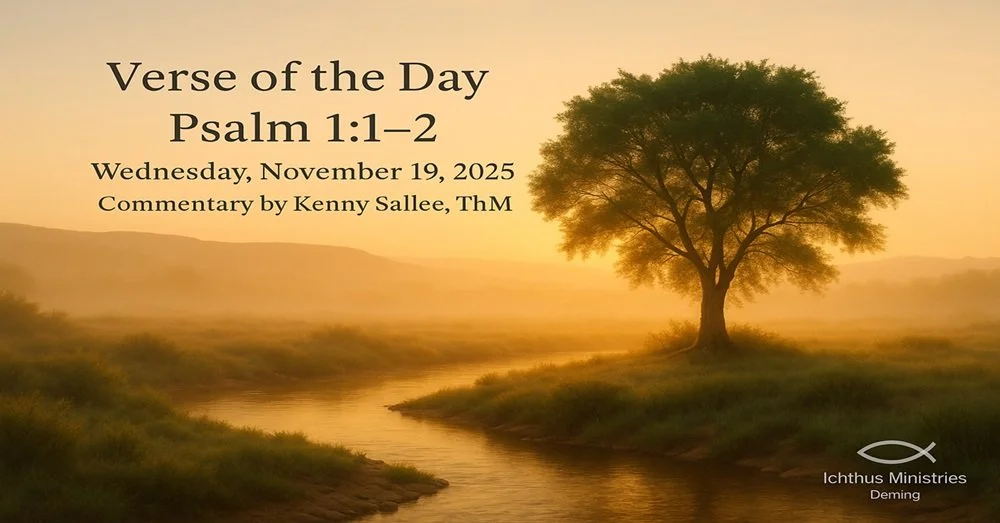
Delighting in the law of the Lord is not about legalism but about love. The more we meditate on Scripture, the more it shapes our moral imagination, our choices, and our inner peace. Modern discipleship thus involves a continual return to the Word—reading, memorizing, and pondering its truths until they transform the heart. Like a tree planted by streams of water (verse 3), those who immerse themselves in God’s instruction will bear fruit even in seasons of drought.
Reflection
Psalm 1:1–2 offers a portrait of the spiritually grounded life—a life shaped not by the shifting patterns of society but by the enduring wisdom of God. It reminds us that happiness and holiness are not opposites but companions, each springing from obedience and communion with the Lord. The psalm’s progression warns against moral drift while offering the remedy of constant meditation on divine truth. In this way, the opening lines of the Psalter set before every believer a timeless invitation: to choose the path of blessing by anchoring one’s thoughts, desires, and daily walk in the living Word of God.
The Bible texts are from the New Revised Standard Version (NRSV) Bible, copyright © 1989, 1993 the Division of Christian Education of the National Council of the Churches of Christ in the United States of America. Used by permission. All rights reserved. Verse of the Day is a daily inspirational and encouraging Bible verse, extracted from BibleGateway.com. Commentary by Kenny Sallee, ThM.
