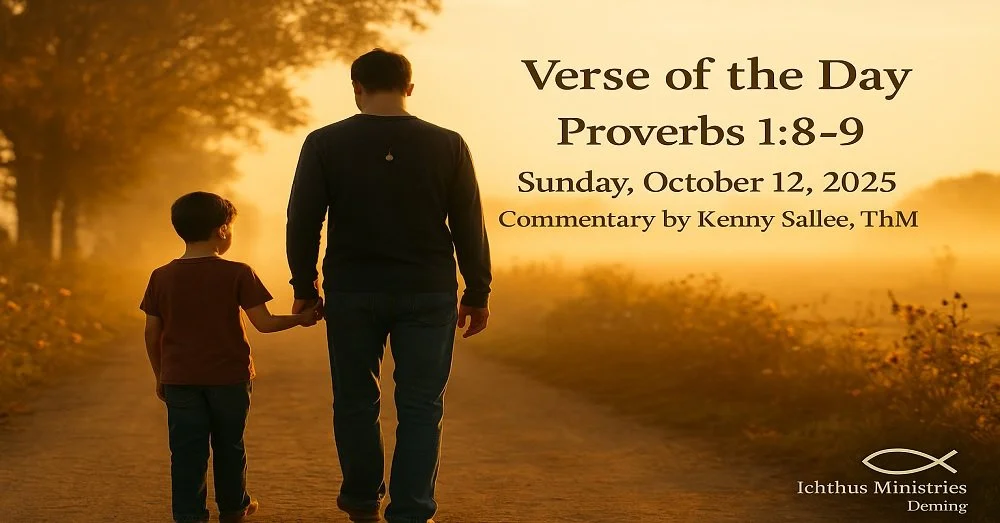
Verse of the Day
Sunday, October 12, 2025
Proverbs 1:8-9
Hear, my child, your father’s instruction, and do not reject your mother’s teaching; for they are a fair garland for your head, and pendants for your neck.
Introduction
The book of Proverbs opens with an appeal to embrace wisdom as a guiding principle of life. These verses establish a foundational theme: the call to listen, honor, and value parental guidance as a means of gaining wisdom. In a collection designed to form character, Proverbs begins not with abstract philosophy but with the simple yet profound call to heed the voices of those who nurture and teach.
Commentary
The passage begins with an imperative: “Hear, my child, your father’s instruction, and do not reject your mother’s teaching.” The Hebrew poetry balances paternal and maternal roles, emphasizing that wisdom is not the domain of one parent alone but is entrusted to both. The child is invited into a posture of receptivity, where listening and not rejecting are acts of respect and trust.
The imagery of a “fair garland for your head” and “pendants for your neck” carries deep symbolic weight. A garland or wreath often represented honor, victory, and blessing in the ancient world. To wear such a crown is to embody dignity and esteem. Similarly, pendants or necklaces were outward signs of beauty, wealth, and identity. Together, these images suggest that wisdom, when received and cherished, becomes both a mark of inner worth and an adornment visible to others.
Understanding the Context
Within Israel’s wisdom tradition, the family home was the first school of moral and spiritual formation. Instruction did not merely involve practical skills but also the transmission of covenantal values—fear of the Lord, justice, integrity, and compassion. Proverbs situates the voice of parents as mediators of divine wisdom, reminding the community that God’s ways are not learned in isolation but in relationship.
The equal mention of father and mother underscores the holistic character of biblical pedagogy. In a patriarchal culture, the inclusion of maternal teaching is striking and signals the shared responsibility of both parents in shaping a child’s moral compass. These verses also fit into the larger theological aim of Proverbs: to guide the young toward the path of life, avoiding folly and destruction.
Application for Today
In our modern world, many voices clamor for attention—media, culture, peers, and personal ambitions. Proverbs reminds us of the enduring value of wisdom passed down through those who have gone before us. For some, this comes through parents; for others, through mentors, teachers, or spiritual guides. The principle remains: to live wisely, we must cultivate humility to listen and discern.
At the same time, Proverbs does not suggest blind obedience but rather a discerning embrace of what is true and life-giving. Not every voice is aligned with God’s wisdom. Thus, the challenge is to hold fast to instruction that leads toward righteousness, peace, and integrity, and to adorn ourselves with it as a crown that reflects our identity as God’s people.
Reflection
Proverbs 1:8–9 invites us to see wisdom as more than information—it is adornment, shaping how we carry ourselves and how others perceive us. Just as a garland or pendant enhances one’s outward appearance, wisdom enhances life itself, bringing honor and integrity. These verses remind us that the way of wisdom is not solitary but relational, built upon the voices of those who teach, guide, and nurture. To treasure such instruction is to wear wisdom as an ornament of life, letting it shape our choices and testify to our character in the world.
The Bible texts are from the New Revised Standard Version (NRSV) Bible, copyright © 1989, 1993 the Division of Christian Education of the National Council of the Churches of Christ in the United States of America. Used by permission. All rights reserved. Verse of the Day is a daily inspirational and encouraging Bible verse, extracted from BibleGateway.com. Commentary by Kenny Sallee, ThM.
