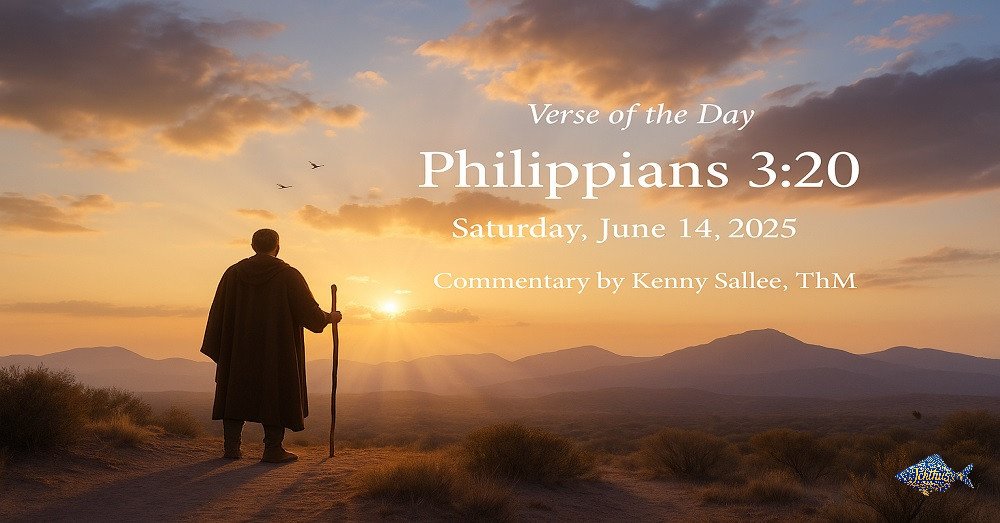
Verse of the Day
Saturday, June 14, 2025
Philippians 3:20
But our citizenship is in heaven, and it is from there that we are expecting a Savior, the Lord Jesus Christ.
Introduction
In an age where identity is often rooted in nationality, politics, or status, Paul offers a bold and countercultural reminder: our true citizenship is in heaven. This verse calls us to lift our eyes beyond earthly allegiances to a greater reality. What does it mean to live not as mere residents of the world, but as citizens of a heavenly kingdom—while still walking the dusty roads of earth?
Commentary
“But our citizenship is in heaven”: The Greek word politeuma (πολίτευμα) implies not only citizenship but also the duties and privileges that come with belonging to a political community. Paul uses it here to signify that Christians belong to a divine commonwealth governed by God, not by Caesar. This heavenly citizenship shapes our allegiance, values, and behavior.
“And it is from there…”: The phrase points to a posture of waiting and expectancy. Our gaze is not inward or backward, but outward and upward—toward heaven.
“…that we are expecting a Savior…”: The verb apekdechometha (ἀπεκδεχόμεθα) conveys active, eager waiting. Unlike passive waiting, this is a hope-filled, watchful anticipation of Christ’s return.
“…the Lord Jesus Christ.”: The full title reinforces both authority (Lord), mission (Jesus, meaning "God saves"), and identity (Christ, the Anointed One). It is from heaven—not Rome or any earthly power—that salvation will ultimately come.
Understanding the Context
Philippians 3 is a passionate appeal by Paul to reject confidence in the flesh—whether through legalism, heritage, or worldly success—and to pursue the surpassing worth of knowing Christ (Phil. 3:7–11). Leading up to verse 20, Paul warns of those who are “enemies of the cross of Christ” (v. 18), whose “minds are set on earthly things” (v. 19). In contrast, believers are reminded that their orientation must be heavenward.
Historically, Philippi was a Roman colony where citizenship was highly prized. Roman citizens enjoyed legal protections and prestige—even in a far-off colony. Paul’s metaphor would have resonated powerfully: just as Philippians lived by the laws and identity of Rome, Christians are to live by the laws and identity of heaven.
Application for Today
In a polarized world filled with political anxiety, shifting cultural norms, and competing ideologies, this verse grounds us in eternal truth. To live as citizens of heaven means:
Prioritizing the values of Christ—humility, mercy, justice—over cultural trends or national pride.
Refusing to idolize earthly power or despair when worldly systems fail.
Living in hopeful anticipation of Christ’s return, even amid suffering, injustice, or delay.
Real-life examples abound: a Christian might choose integrity over career advancement, forgiveness over revenge, or generosity over self-preservation—because they answer to a higher King. Citizenship in heaven compels us to be ambassadors of grace on earth.
Reflection
Are you living like a traveler with a passport stamped by heaven, or have you become too comfortable in the temporary camps of this world?
Let us remember that we are pilgrims, not permanent residents here.
The Bible texts are from the New Revised Standard Version (NRSV) Bible, copyright © 1989, 1993 the Division of Christian Education of the National Council of the Churches of Christ in the United States of America. Used by permission. All rights reserved. Verse of the Day is a daily inspirational and encouraging Bible verse extracted from BibleGateway.com. Commentary by Kenny Sallee, ThM.
