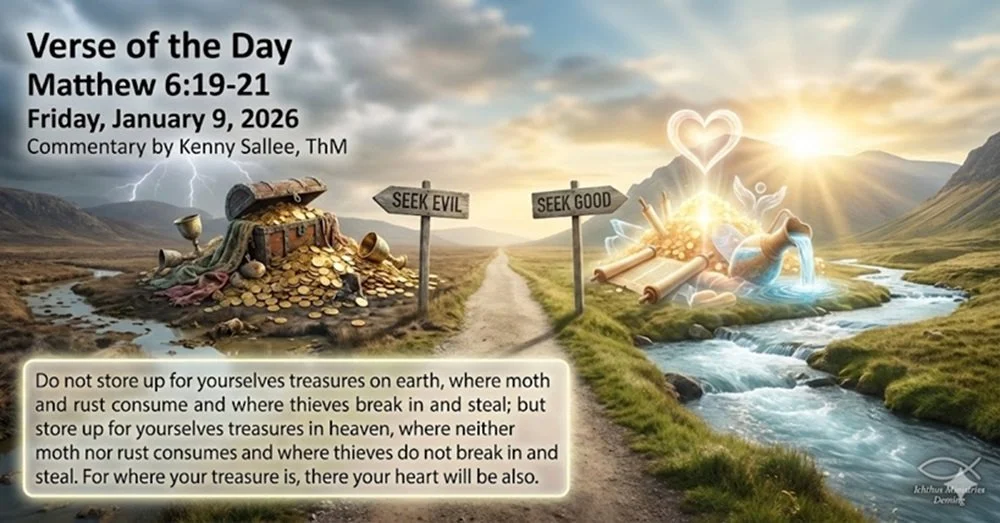
Verse of the Day
Friday, January 9, 2026
Matthew 6:19-21
Do not store up for yourselves treasures on earth, where moth and rust consume and where thieves break in and steal; but store up for yourselves treasures in heaven, where neither moth nor rust consumes and where thieves do not break in and steal. For where your treasure is, there your heart will be also.
Introduction
In the Sermon on the Mount, Jesus outlines the ethics of the Kingdom of Heaven, contrasting them with the prevailing standards of the world. Having addressed the proper motivations for religious practices such as almsgiving, prayer, and fasting in the first half of Matthew 6, Jesus shifts his focus to the believer’s relationship with the material world. Matthew 6:19–21 serves as a pivotal moment in this discourse, moving from the realm of religious piety to the everyday struggle with security and desire.
The central theme of this passage is the orientation of the human heart. Jesus challenges his hearers to recognize that "treasure" is not merely about financial accumulation but about what one values supremely. He establishes a binary opposition between earthly security, which is inherently fragile, and heavenly security, which is enduring. By linking the location of one’s treasure to the location of one’s heart, Jesus prepares the reader to examine not just their bank accounts, but the fundamental allegiances of their inner life.
Commentary
Verse 19: The Fragility of Earthly Security
“Do not store up for yourselves treasures on earth, where moth and rust consume and where thieves break in and steal;”
Jesus begins with a negative command, prohibiting the hoarding of material wealth for self-centered security. The imagery he uses is specific to the ancient world but speaks to universal truths. "Treasures on earth" are depicted as vulnerable to three threats: biological decay ("moth"), physical corrosion or consumption ("rust"), and human malevolence ("thieves"). The mention of the moth reminds the reader that in the ancient world, wealth was often held in the form of fine garments; "rust" (or brosis, literally "eating" or "consumption") suggests the spoilage of grain or the tarnishing of metals. Jesus is highlighting the inevitable transience of physical matter. No matter how well protected, earthly assets are subject to entropy and loss.
Verse 20: The Permanence of Heavenly Investment
“but store up for yourselves treasures in heaven, where neither moth nor rust consumes and where thieves do not break in and steal.”
In contrast, Jesus offers a positive command: to accumulate "treasures in heaven." While he does not explicitly define this treasure in this specific verse, the broader context of Matthew suggests it consists of acts of righteousness, mercy, and obedience to God (as seen in the Beatitudes and the instructions on almsgiving). These investments are placed in a realm beyond the reach of decay and theft. The language implies that "heaven" is not just a future destination, but a present secure vault for the spiritual fruits of a life lived in alignment with God’s will.
Verse 21: The Magnetic Pull of the Heart
“For where your treasure is, there your heart will be also.”
This verse provides the theological axiom that undergirds the previous commands. It reveals a psychological and spiritual law: human affection follows human investment. We do not merely put our treasure where our heart is; rather, our heart eventually gravitates toward where we have placed our treasure. If one invests heavily in earthly status or security, their inner self—their hopes, fears, and preoccupations—will be anchored to the temporal world. If one invests in the Kingdom, their heart becomes anchored in God.
Understanding the Context
To fully grasp the impact of this teaching, one must understand the first-century Jewish context regarding wealth. In the agrarian society of Galilee and Judea, "treasure" was tangible. Banks and digital ledgers did not exist; wealth was stored in the home (buried in floors or kept in chests), worn on the body, or stored in barns. This made the threat of "thieves digging through" (the literal Greek translation of "break in") and vermin destroying fabrics a daily anxiety.
Theologically, Jewish wisdom literature often struggled with the duality of wealth. While material prosperity was sometimes viewed as a sign of divine blessing (Deuteronomy 28), the prophets and wisdom writers frequently warned against the deceitfulness of riches. There was also a strong tradition, particularly in intertestamental literature (such as Tobit and Sirach), that viewed almsgiving as a way of depositing treasure in heaven. For example, Tobit 4:8–9 advises, "So you will be laying up a good treasure for yourself against the day of necessity."
Jesus builds upon this foundation but radicalizes it. He does not suggest that wealth is merely dangerous, but that it competes for lordship. In the context of the Sermon on the Mount, this passage sits between the section on "religious hypocrisy" and the teaching on "anxiety." It serves as the bridge: a heart fixated on earthly treasure will inevitably be a heart filled with anxiety (Matthew 6:25–34), whereas a heart fixed on heaven finds liberation.
Application for Today
In the contemporary world, "moth and rust" may not threaten our bank accounts, but the principle of fragility remains. Today, "treasures on earth" take the form of stock market portfolios, real estate, career reputation, and even the curation of a digital identity. We "store up" value in the pursuit of comfort, the accumulation of experiences, or the validation of others. Just as ancient garments could be eaten by moths, modern investments can be wiped out by economic recessions, and reputations can be destroyed by a single public misstep.
Jesus’ teaching challenges the modern idol of "security." We often believe that if we accumulate enough, we will finally be safe. Jesus argues that accumulation actually increases vulnerability, because it gives us more to lose.
To "store up treasures in heaven" today invites a re-ordering of priorities. It suggests that our resources—time, money, and talent—should be viewed as capital to be invested in people and God’s purposes, rather than hoarded for self-preservation. This might look like radical generosity, choosing ethical integrity over profit, or prioritizing relationships over professional advancement. It is a call to live loosely with material things so that they do not possess us.
Reflection
The words of Christ in this passage invite a rigorous audit of the soul. It is easy to verbally affirm that God is our priority, but the specific allocation of our resources often tells a truer story. We must ask ourselves: What do we fear losing the most? What occupies our thoughts when we lie awake at night? These anxieties are often the compass needles pointing directly to where our true treasure lies.
If we find that our sense of well-being rises and falls with the stock market, the condition of our home, or the approval of our peers, we have likely anchored our hearts in the temporal. The invitation of this passage is not to abandon all planning or prudence, but to shift the center of our gravity. By consciously choosing to value acts of mercy, character, and faithfulness above material gain, we slowly relocate our hearts. We move from a posture of defensive hoarding to one of open-handed freedom, securing our lives in the only place that cannot be shaken.
The Bible texts are from the New Revised Standard Version (NRSV) Bible, copyright © 1989, 1993 the Division of Christian Education of the National Council of the Churches of Christ in the United States of America. Used by permission. All rights reserved. Verse of the Day is a daily inspirational and encouraging Bible verse, extracted from BibleGateway.com. Commentary by Kenny Sallee, ThM.
