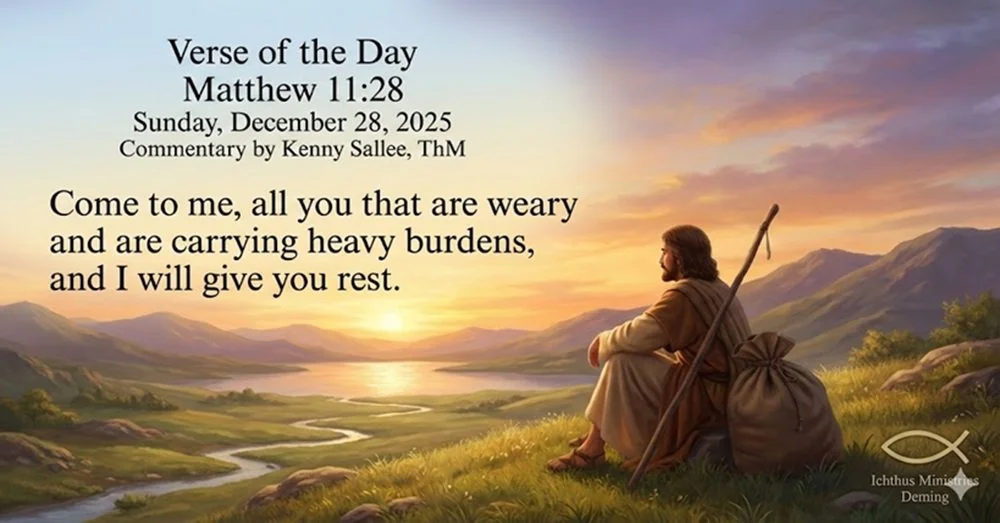
Verse of the Day
Sunday, December 28, 2025
Matthew 11:28
Come to me, all you that are weary and are carrying heavy burdens, and I will give you rest.
Introduction
Matthew 11:28 stands as one of the most tender and compelling invitations in the New Testament. In this verse, Jesus addresses the universal human condition of exhaustion and the need for relief, extending a personal call to those weighed down by the struggles of life and faith. Situated within the Gospel of Matthew, this invitation serves as a pivotal moment where the nature of discipleship is redefined—not as an accumulation of rigid obligations, but as a relationship with a compassionate Messiah. It underscores the themes of divine rest and grace, offering a counter-cultural vision of authority that seeks to alleviate burdens rather than impose them.
Commentary
This verse centers on three critical theological movements: the call, the condition of the audience, and the promise.
The Call: Jesus begins with the imperative "Come to me." This is not merely a summons to a location or a philosophy, but to a person. It establishes Christology at the heart of relief; Jesus presents Himself as the locus of rest and the source of renewal.
The Condition: Jesus addresses two specific groups, often understood as two sides of the same coin.
Those who labor (Greek: kopiōntes): This term refers to those who are working to the point of exhaustion or fatigue. It implies active, strenuous effort—a "weariness" that comes from striving.
Those who are burdened (Greek: pephortismenoi): This is a passive participle, describing those who have had a heavy load placed upon them by others. It suggests a state of being weighed down by external forces or obligations.
Together, these terms paint a picture of total depletion—both from what we do (active striving) and what is done to us (passive burden-bearing).
The Promise: The conclusion of the verse, "I will give you rest," translates to "I will cause you to rest" or "I will refresh you." In the biblical tradition, "rest" is not simply the cessation of activity (idleness) but is deeply connected to Shalom—peace, wholeness, and the restoration of relationship with God. Jesus claims the authority to provide this divine rest, a prerogative often reserved for God alone in the Old Testament.
Understanding the Context
To fully grasp the weight of this invitation, one must look at the historical and religious landscape of first-century Judea. Jesus was speaking to a people living under the dual pressures of Roman occupation and rigorous religious expectation.
Religious Burdens: The Scribes and Pharisees had developed a complex system of oral traditions intended to build a "fence" around the Torah (the Law). While often well-intentioned, these interpretations had evolved into a heavy yoke of legalism—detailed rules regarding Sabbath observance, tithing, and ritual purity that were difficult for the common person (the am ha'aretz) to maintain. In Matthew 23:4, Jesus explicitly critiques the religious leaders for tying up "heavy burdens" and laying them on people’s shoulders without lifting a finger to help.
The Literary Setting: Matthew 11 marks a turning point where Jesus faces growing opposition from these very leaders. Immediately preceding this verse (Matthew 11:25-27), Jesus thanks the Father for hiding these truths from the "wise and intelligent" and revealing them to "infants." By offering rest to the "weary," Jesus is contrasting His "yoke" of discipleship (mentioned in verse 29) with the heavy yoke of Pharisaic legalism. He is redefining what it means to be a faithful member of the covenant community—shifting the focus from achieving legal perfection to abiding in a relationship of trust.
Application for Today
While the historical context involved the Mosaic Law, the application of Matthew 11:28 resonates deeply with contemporary experience. The "yoke" has changed, but the weariness remains.
The Burden of Performance: Many today suffer from spiritual or secular exhaustion driven by the need to prove their worth. This reflects the kopiōntes—the active striving to be successful, righteous, or accepted. Jesus’ invitation challenges the modern idol of productivity, reminding us that our value is found in coming to Him, not in our output.
Spiritual Burnout: For those involved in ministry or caregiving, the weight of others' needs can become crushing. The promise of rest is a reminder that Jesus is the ultimate burden-bearer. Discipleship is not meant to be a solo act of heroism but a shared walk where Christ carries the heaviest load.
The Weight of Grief and Anxiety: The "heavy burdens" (pephortismenoi) we carry today often take the form of anxiety, grief, or systemic injustice. These are loads placed upon us that we did not choose. Jesus acknowledges this reality and offers a sanctuary where these burdens are acknowledged and validated, rather than dismissed.
The verse invites a shift from a transaction-based faith (doing things to earn God's favor) to a relationship-based faith (resting in what Christ has already done).
Reflection
The invitation to "come" requires a deliberate response of trust and surrender. It asks the individual to acknowledge their own limitations and to relinquish the need for total control over their spiritual or physical circumstances. True rest, in this sense, is an act of humility; it admits that human strength is insufficient to carry the weight of the world or the demands of the soul. Readers might consider where they are currently sensing the greatest weight—whether it is the fatigue of constant doing or the pressure of unfulfilled expectations—and examine if they are attempting to carry these loads in isolation. The movement toward Jesus is a movement toward a center of gravity where the burden is shared, offering a profound reassurance that one does not have to sustain their life solely by their own power.
The Bible texts are from the New Revised Standard Version (NRSV) Bible, copyright © 1989, 1993 the Division of Christian Education of the National Council of the Churches of Christ in the United States of America. Used by permission. All rights reserved. Verse of the Day is a daily inspirational and encouraging Bible verse, extracted from BibleGateway.com. Commentary by Kenny Sallee, ThM.
