Verse of the Day
Monday, December 22, 2025
Luke 2:8-11
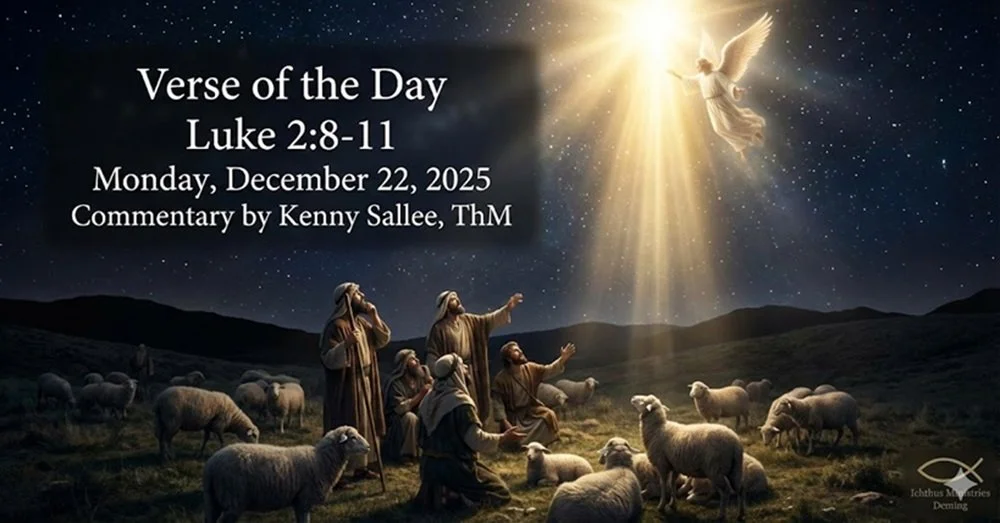
In that region there were shepherds living in the fields, keeping watch over their flock by night. Then an angel of the Lord stood before them, and the glory of the Lord shone around them, and they were terrified. But the angel said to them, “Do not be afraid; for see—I am bringing you good news of great joy for all the people: to you is born this day in the city of David a Savior, who is the Messiah, the Lord.”
Introduction
This passage marks a dramatic shift in the Lukan narrative of the Nativity. having moved from the intimate, quiet setting of the birth in Bethlehem (verses 1-7) to the open fields of the surrounding region. The focus turns from the holy family to a group of anonymous shepherds engaged in their nightly labor. This scene serves as the first public announcement of the Incarnation, bridging the gap between the divine event and human witness. The sudden intrusion of the celestial into the mundane establishes a key Lukan theme: the Gospel is revealed in the midst of ordinary life.
Commentary
"In that region there were shepherds living in the fields..."
The text emphasizes the locality ("that region") and the activity ("keeping watch"). The Greek suggests a continuous action; they were living out in the open. This grounds the narrative in historical realism—these are working-class laborers, not religious elites.
"Then an angel of the Lord stood before them, and the glory of the Lord shone around them..."
The appearance is sudden. The "glory of the Lord" (doxa) recalls the Shekinah glory of the Old Testament—the visible manifestation of God’s presence that filled the Tabernacle and Temple. Now, that same glory illuminates a pasture, signifying that God’s presence has broken out of the Temple confines. The reaction, "terrified" (literally "feared a great fear"), is the standard biblical response to divine revelation.
"I am bringing you good news of great joy for all the people..."
The angel uses the verb euangelizomai ("I bring good news"), the root of "evangelism." The scope of this news is crucial: it is "for all the people" (panti tō laō). While it begins with Israel, Luke’s Gospel eventually extends this "all" to the Gentiles.
"To you is born this day in the city of David a Savior, who is the Messiah, the Lord."
This is a christological powerhouse verse.
"To you": The birth is personal and for the benefit of these lowly witnesses.
"Savior" (Sōtēr): A title used for God, but also politically for Caesar (who was mentioned in v.1). Luke posits Jesus as the true bringer of peace and rescue.
"Messiah" (Christos): The Anointed One expected by Jewish tradition.
"Lord" (Kyrios): The divine title used in the Septuagint for Yahweh.
Understanding the Context
To fully grasp the shock of this passage, one must understand the social standing of shepherds in the first century. While the patriarchs and King David were shepherds, by the first century, the profession had lost its luster in many eyes. Because their work kept them away from home and often prevented strict observance of ceremonial washing and Sabbath laws, they were frequently marginalized and considered religiously "unclean" or unreliable by the meticulous standards of the Pharisees.
The theological irony here is intentional. The announcement of the Davidic King was not made to the religious authorities in Jerusalem or the political powers in Rome, but to those on the margins. This validates the "upside-down" nature of God’s Kingdom, where the humble are exalted (Luke 1:52).
Application for Today
The Disruption of the Divine: Just as the shepherds were interrupted during a mundane night shift, God often speaks into our lives not during "spiritual" highs, but in the middle of our daily grind—our work, our stress, and our routines.
Reclaiming the "Good News": In a world saturated with "bad news" cycles, this passage reminds us that the core of the Christian message is joy. It is an objective reality ("to you is born") rather than just a subjective feeling.
Inclusivity of the Gospel: The phrase "for all the people" challenges modern tribalism. The message given to the shepherds is that no one is too ordinary, too "unclean," or too far removed from religious centers to be excluded from the invitation of God.
Reflection
The narrative of Luke 2:8-11 confronts us with the radical humility of God. The selection of the audience is as significant as the message itself. By bypassing the palaces of Herodium and the courts of the Temple to speak to shepherds, God dismantled human hierarchies of worthiness. The "sign" given to them was not a display of power, but an invitation to witness vulnerability—a baby. This passage suggests that to find the Divine, one must be willing to look in the unexpected places and listen to the testimony of the unexpected people. It is a theological assertion that dignity is bestowed by God, not earned by social standing.
The Bible texts are from the New Revised Standard Version (NRSV) Bible, copyright © 1989, 1993 the Division of Christian Education of the National Council of the Churches of Christ in the United States of America. Used by permission. All rights reserved. Verse of the Day is a daily inspirational and encouraging Bible verse, extracted from BibleGateway.com. Commentary by Kenny Sallee, ThM.
