Verse of the Day
Friday, December 26, 2025
Luke 2:28-32
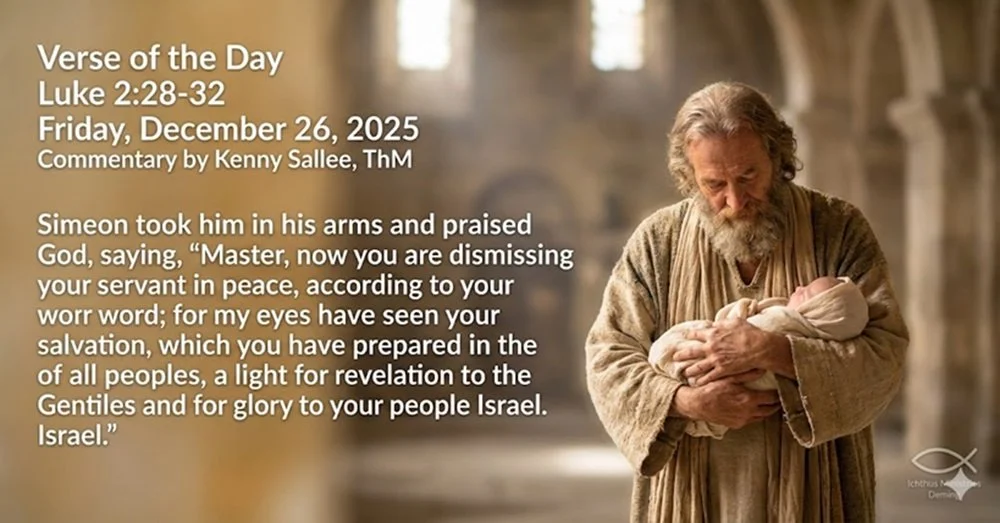
Simeon took him in his arms and praised God, saying, “Master, now you are dismissing your servant in peace, according to your word; for my eyes have seen your salvation, which you have prepared in the presence of all peoples, a light for revelation to the Gentiles and for glory to your people Israel.”
Introduction
The narrative scene is set within the precincts of the Jerusalem Temple, the beating heart of Jewish religious life. Mary and Joseph have arrived to fulfill the requirements of the Mosaic Law—specifically the purification of the mother and the redemption of the firstborn son. Amidst the bustle of ritual activity and the smoke of sacrifices, Luke draws our attention to a singular encounter. We are introduced to Simeon, a figure who embodies the faithful remnant of Israel. Luke characterizes him with three distinct strokes: he is "righteous and devout," signifying his moral integrity and religious observance; he is looking forward to the consolation of Israel; and, crucially, the Holy Spirit rests upon him.
This passage represents a climactic intersection where human longing meets divine fulfillment. Simeon is not merely an old man holding a baby; he is the personification of centuries of prophetic hope finally embracing the Incarnate Word. In this moment, the finite timeline of human expectation converges with the eternal timeline of God's redemptive plan.
Understanding the Context
To grasp the weight of Simeon’s song, one must understand the atmosphere of Second Temple Judaism. The Jewish people were living under Roman occupation, a period marked by political turbulence and spiritual anxiety. The phrase "looking forward to the consolation of Israel" (v. 25) is charged with theological significance. It refers to the deep, collective yearning for the Messiah who would comfort God’s people, functioning as a fulfillment of the prophecies of Isaiah (specifically Isaiah 40:1, "Comfort, O comfort my people"). This was not a passive waiting, but an active, tension-filled expectation of divine intervention.
Luke places specific literary emphases in this chapter to guide the reader’s understanding. First, he underscores the role of the Holy Spirit. Before Simeon speaks a word, Luke tells us three times that the Spirit is active: the Spirit is on him, the Spirit revealed the promise to him, and the Spirit guided him into the temple. This highlights that the recognition of Jesus as Messiah is not a result of human deduction, but of divine revelation. Second, Luke emphasizes faithful obedience to the Law. He repeatedly mentions that Jesus’s parents are doing "what was customary under the law," grounding the radical newness of the Gospel within the ancient, covenantal faithfulness of Israel.
Commentary
Verse 28: The Embrace of Promise
"Simeon took him in his arms and praised God..."
The physical action here is profound. Simeon does not merely look at the child; he takes him into his arms. This gesture symbolizes the tangible reception of God's promise. Faith, for Simeon, is not an abstract intellectual assent but a physical embrace of God’s gift. In receiving the child, he receives the salvation the child embodies.
Verse 29: The Release of the Sentinel
"Master, now you are dismissing your servant in peace, according to your word;"
These opening words of the Nunc Dimittis (Latin for "Now you dismiss") utilize the language of manumission or military service. Simeon refers to God as Despota (Master) and himself as a doulos (servant or slave). The imagery is that of a watchman who has stood at his post through a long, dark night, waiting for the sunrise. Now that the sun has risen, the commander has given the order to stand down. "Peace" (eirēnē) here is not just psychological calm, but the profound shalom—wholeness and completion—that comes from a duty fulfilled and a promise kept.
Verse 30: Seeing Salvation
for my eyes have seen your salvation,"
In the Old Testament, salvation is often described as an action of God (deliverance from enemies, rescue from sin). Here, Simeon identifies salvation not as an event or a concept, but as a person. To look upon the infant Jesus is to look upon salvation itself. This shifts the theological focus from what God will do to who God has sent. The "eyes" that see salvation suggest that spiritual insight has now become physical reality; the invisible hope has become visible flesh.
Verses 31-32: Universal Scope and Dual Role
"which you have prepared in the presence of all peoples, a light for revelation to the Gentiles and for glory to your people Israel."
Simeon’s praise moves from the personal ("my eyes") to the universal ("all peoples"). He delineates the dual role of the Messiah, echoing the Servant Songs of Isaiah (Isa 42:6, 49:6).
A Light for Revelation to the Gentiles: This is a radical declaration in a context where messianic hope was often viewed as exclusive to Israel. Simeon proclaims that this child will tear away the veil of darkness covering the nations, bringing the knowledge of the true God to the entire world.
Glory to your people Israel: While the Gentiles receive revelation (light), Israel receives glory. Jesus is the crowning achievement of Israel's history, the vindication of their suffering, and the fulfillment of their covenant. He is not a replacement of Israel, but its ultimate glory.
Application for Today
Active Waiting vs. Modern Impatience
We live in an age of immediacy, where waiting is often viewed as a nuisance or a waste of time. Simeon serves as a counter-cultural model of "active waiting." His waiting was not idle; it was characterized by devotion, righteousness, and attunement to the Spirit. For contemporary believers, this challenges the desire for instant spiritual gratification. It suggests that God’s promises often mature slowly, requiring a posture of enduring faithfulness rather than demanding urgency.
Recognizing Salvation in Vulnerable Forms
Simeon recognized the "salvation of the world" in the form of a helpless, forty-day-old infant brought by a poor couple offering two turtledoves. He did not look for a warrior king or a display of cosmic power. Today, this challenges the church to recognize God’s presence in the small, the vulnerable, and the ordinary. It invites a critique of our tendency to associate God’s blessing solely with success, power, or spectacle.
Universal Salvation in a Pluralistic World
Simeon’s prophecy that Jesus is a "light for revelation to the Gentiles" reminds the modern church of the intrinsic universality of the Gospel. In a fractured and polarized world, this text asserts that Christ is not the possession of a single culture or nation. The application for today is a call to mission that crosses ethnic and cultural boundaries, recognizing that the "glory" of faith is meant to be shared with "all peoples."
Reflection
The narrative of Simeon presents a profound theological paradox: the end of a life finds its ultimate peace in the beginning of a new one. Simeon can face his own mortality ("dismissing your servant") without fear, not because he has conquered death, but because he has held Life itself in his arms. The text suggests that true peace is found not in the accumulation of years, but in the encounter with the Divine promise.
Furthermore, we see the beautiful tension in God’s plan between the particular and the universal. God worked through a specific people (Israel), a specific law, and a specific family to bring about a salvation that has no borders. The "glory" of the particular becomes the "light" for the universal. This scene at the Temple invites us to contemplate that the specific, concrete acts of God in history are the very hinges upon which the door of eternity swings open for everyone.
The Bible texts are from the New Revised Standard Version (NRSV) Bible, copyright © 1989, 1993 the Division of Christian Education of the National Council of the Churches of Christ in the United States of America. Used by permission. All rights reserved. Verse of the Day is a daily inspirational and encouraging Bible verse, extracted from BibleGateway.com. Commentary by Kenny Sallee, ThM.
