Verse of the Day
Wednesday, December 24, 2025
Luke 2:16-20
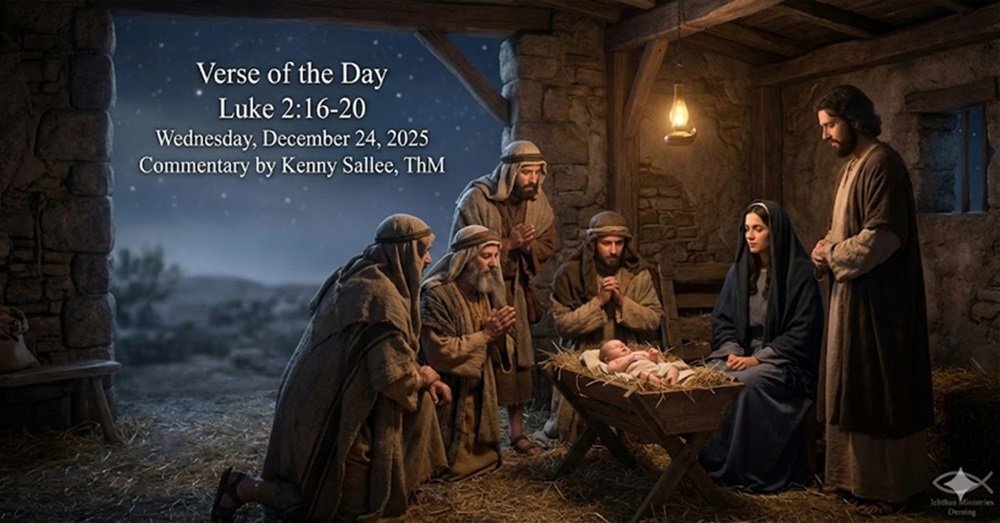
So they went with haste and found Mary and Joseph, and the child lying in the manger. When they saw this, they made known what had been told them about this child; and all who heard it were amazed at what the shepherds told them. But Mary treasured all these words and pondered them in her heart. The shepherds returned, glorifying and praising God for all they had heard and seen, as it had been told them.
Introduction
The echo of the angelic chorus has just faded into the dark Judean sky. The shepherds, previously paralyzed by fear and then awestruck by glory, are now propelled by a singular purpose. The narrative shifts from the cosmic grandeur of the heavenly host to the gritty, earthy reality of a stable. In these verses, we witness the intersection of heaven and earth—not in a palace, but in the raw vulnerability of a feeding trough. The scene captures a profound urgency; the shepherds do not debate the vision or wait for dawn. They move with haste, driven by the need to verify the divine sign that promised peace to a weary world.
Commentary
The Haste of Faith (v. 16)
The text notes that the shepherds went "with haste." This is not merely an indication of speed, but of spiritual eagerness. In the biblical narrative, when God reveals, the appropriate human response is immediate action. This haste signifies an unburdened faith—they left their flocks (their livelihood and duty) to seek the Messiah. Upon arrival, they found the holy family and the baby lying in the manger, confirming the angel's specific sign.
The Sign of the Manger (v. 16)
The manger is the pivot point of the Incarnation. It emphasizes the physical reality of God becoming man. Jesus was not an apparition; He was a baby who needed to be fed, held, and placed in a trough intended for animals. This "sign" serves a dual purpose: it verifies the angel's message to the shepherds (who would recognize such a humble setting instantly), and it foreshadows the Eucharistic theology of Christ as the "Bread of Life" given for the world.
Amazement vs. Contemplation (v. 18-19)
Luke draws a sharp distinction between two types of reactions. When the shepherds recount what they were told, "all who heard it were amazed." Amazement (thaumazo), however, is often a fleeting emotion in the Gospels—crowds are often amazed by miracles but later turn away.
In contrast, "Mary treasured all these words and pondered them in her heart." The Greek word for "pondered" (symballousa) implies "casting together" or piecing things together like a puzzle. Mary does not simply react; she internalizes the event, actively seeking to understand the deep theological threads weaving her son's life together.
Witnesses to Messengers (v. 17, 20)
The shepherds undergo a radical transformation. They arrive as recipients of a message, but they leave as its first proclaimers. Verse 17 states, "they made known what had been told them." Having encountered the Living Word, they cannot remain silent. Their return to the fields is not a return to the status quo; they return "glorifying and praising God." Their external circumstances (the sheep, the night watch) haven't changed, but their internal reality has been permanently altered.
Understanding the Context
To fully grasp the shock of this narrative, one must understand the social standing of shepherds in first-century Judea. By this period, shepherding had lost the patriarchal dignity it held during the time of David. Shepherds were often viewed with suspicion, considered ceremonially unclean due to their contact with animals and inability to strictly keep the Sabbath, and were sometimes rendered ineligible to give testimony in legal courts.
Theologically, God’s choice to reveal the Incarnation to this specific demographic is a subversive reversal of human hierarchy. It is the Gospel of the Marginalized. God bypasses the religious elite in Jerusalem and the political powers in Rome to entrust the greatest news in history to those on the fringes of society. This establishes a key Lukan theme: the Kingdom of God belongs to the humble, the poor, and the outcast.
Application for Today
The Haste to Encounter
In a modern world characterized by busyness and distraction, we often make haste away from God rather than toward Him. The shepherds challenge us to prioritize the spiritual life. When the "good news" breaks into our lives—be it through scripture, liturgy, or a moment of grace—our response should be immediate and active, prioritizing the presence of Christ over our daily routines.
The Art of Pondering
We live in an age of information overload, where we consume content rapidly but rarely digest it. Mary’s example calls us to the discipline of contemplation. It is not enough to be "amazed" by the Christmas story or a Sunday sermon; we must "treasure and ponder" these truths, allowing them to sink deep into our hearts until they shape our identity and actions.
Evangelism of Experience
The shepherds did not have theological training; they simply shared what they had seen and heard. This is a model for personal evangelism. We are not called to have all the answers, but to bear witness to our personal encounter with Jesus. Like the shepherds, our worship and our work should be integrated; we return to our "flocks"—our jobs, families, and communities—praising God and sharing the reality of His presence.
Reflection
The narrative of the nativity invites us to move beyond the sentimentality of the season into the radical reality of the Incarnation. We are asked to navigate the tension between the shepherds' frantic joy and Mary's quiet depth. True discipleship requires both: the enthusiasm to run toward Christ and the wisdom to sit still in His presence. As we step out of the scriptures and back into our own lives, the challenge is to carry the light of the stable into the darkness of our own "fields," ensuring that the glory we have witnessed does not fade with the sunrise, but fuels a life of perpetual praise and witness.
The Bible texts are from the New Revised Standard Version (NRSV) Bible, copyright © 1989, 1993 the Division of Christian Education of the National Council of the Churches of Christ in the United States of America. Used by permission. All rights reserved. Verse of the Day is a daily inspirational and encouraging Bible verse, extracted from BibleGateway.com. Commentary by Kenny Sallee, ThM.
