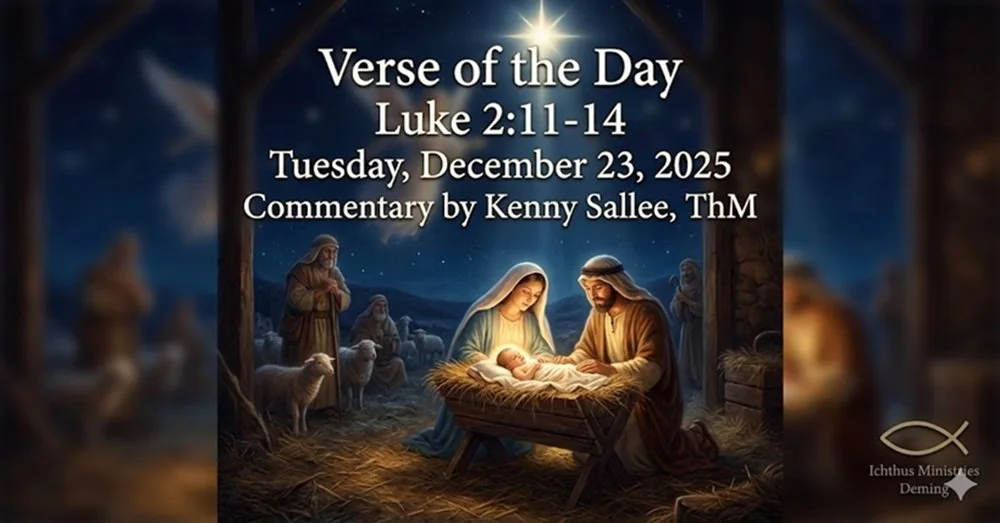
Verse of the Day
Tuesday, December 23, 2025
Luke 2:11-14
To you is born this day in the city of David a Savior, who is the Messiah, the Lord. This will be a sign for you: you will find a child wrapped in bands of cloth and lying in a manger.” And suddenly there was with the angel a multitude of the heavenly host, praising God and saying, “Glory to God in the highest heaven, and on earth peace among those whom he favors!”
Introduction
The narrative context of Luke 2:11-14 is one of stark juxtaposition. The scene opens not in the halls of power in Rome or the religious epicenter of Jerusalem, but in the dark, open fields outside Bethlehem. Here, an angel of the Lord breaks the silence of the night, appearing to shepherds—figures who occupied the social and religious margins of Judean society.
The theological thrust of this announcement is the revelation of the identity of the child born in Bethlehem. While the birth itself is recounted with brevity in earlier verses, this angelic proclamation serves as the interpretative key for the entire infancy narrative. It declares that the event is not merely the birth of a child, but a decisive intervention of God into human history, redefining the nature of power, salvation, and divine presence.
Commentary
The Tripartite Title (v. 11)
"to you is born this day in the city of David a Savior, who is the Messiah, the Lord."
This single verse contains a christological density rare in the Synoptic Gospels, converging three distinct and weighty titles onto the newborn Jesus:
Savior (Sōtēr): In the Old Testament, God alone is the Savior of Israel. By applying this title to the child, the angel identifies Jesus as the agent of divine deliverance—not just from political oppression, but from the fundamental alienation of sin.
Messiah (Christos): This confirms the child as the "Anointed One," the long-awaited Davidic king who fulfills Israel’s covenantal hopes.
Lord (Kyrios): This is perhaps the most radical claim. In the Greek Old Testament (Septuagint), Kyrios was the standard substitute for the divine name, YHWH. To call the child Kyrios is to ascribe to him divine authority and identity.
The convergence of these titles signals that the hopes of Israel (Messiah) and the sovereignty of God (Lord) are now fully present in this one human life.
The Paradoxical Sign (v. 12)
"This will be a sign for you: you will find a child wrapped in bands of cloth and lying in a manger."
The angel offers a "sign" to verify this cosmic claim. Typically, a sign of royal birth would involve purple robes or a palace. Here, the sign is paradoxical: "bands of cloth" (swaddling clothes indicating total dependence) and a "manger" (a feeding trough for animals).
This presents a profound theology of Incarnation. The God who is "Lord" and "Savior" does not arrive with overwhelming force but in vulnerability. The manger serves as a visual metaphor for God’s self-emptying love (kenosis). The Creator becomes accessible to his creatures, effectively becoming "food" for the world—a theme that foreshadows the Eucharist. The majesty of verse 11 is grounded in the humility of verse 12.
The Angelic Hymn (vv. 13-14)
“Glory to God in the highest heaven, and on earth peace among those whom he favors!”
The Gloria establishes a vertical axis (heaven/earth) and a corresponding relational axis (glory/peace). The glory of God in the highest realms is not hoarded; it overflows into peace on earth.
Crucially, the NRSVCE renders the final phrase "among those whom he favors" (translating the Greek eudokia). This corrects the older translation "good will toward men," which implied peace was a reward for human good will. Instead, eudokia refers to God’s gracious choice and good pleasure. The peace proclaimed here is not a human achievement or a cessation of conflict; it is Shalom—wholeness and reconciliation resulting from God’s unmerited favor toward humanity.
Understanding the Context
Greco-Roman Context: A Subversive Gospel
Luke’s audience would have immediately recognized the political weight of the angel's proclamation. The Roman Emperor Augustus was hailed as "Savior" of the world; his birthday was celebrated as "good news" (gospel); and the stability he enforced through military might was known as the Pax Romana (Peace of Rome).
By applying the titles "Savior," "Lord," and "Peace" to Jesus, Luke is constructing a counter-narrative. The text asserts that true peace does not come from the sword of Caesar but from the child in the manger. It challenges the absolute authority of the Empire, positing that the true Lord of the world is not the one on the throne in Rome, but the one lying in a trough in Bethlehem.
Jewish Context: Reversal of Expectations
Jewish messianic expectation often looked for a warrior-king who would liberate Israel from foreign rule and restore the Temple's glory. The revelation of this Messiah to shepherds is a shocking reversal. In first-century Judaism, shepherding was a despised trade; shepherds were often considered ceremonially unclean and untrustworthy, barred from giving testimony in court.
That God chooses these "outsiders" to be the first theologians and evangelists underscores the nature of the Kingdom. The "city of David" (Bethlehem) is emphasized not to highlight royal pomp, but to recall David’s humble origins as a shepherd. The Incarnation bypasses the religious elite to locate God’s presence among the lowly.
Application for Today
Critiquing the "Will to Power"
The "manger strategy" of God offers a searing critique of the modern obsession with status, influence, and self-sufficiency. We live in a culture that equates value with visibility and power with domination. The Incarnation reveals that God is most present where we least expect Him: in vulnerability, in the ordinary, and in the margins. For the modern believer, this necessitates a shift in values—moving away from the accumulation of power and toward a willingness to serve in humility. It asks us to look for the sacred not in the spectacular, but in the quiet, overlooked corners of our communities.
Embodying Peace in a Divided World
The peace announced by the angels is not a passive sentiment; it is a reality grounded in God’s favor. In a world fractured by political polarization and violence, the church is called to be the embodiment of this "peace on earth." This requires more than conflict avoidance; it requires active reconciliation. Just as God crossed the boundary between heaven and earth to bring peace, believers are called to cross social, racial, and political boundaries to extend that peace. We are to be agents of eudokia—demonstrating God’s good pleasure toward others, especially those whom society deems unworthy.
Reflection
The narrative of Luke 2 forces us to confront the scandal of particularity: that the Infinite chose to become finite, that the Sustainer of the Universe allowed Himself to be held in human arms. This is not a God who remains safely abstract or distant, but one who descends into the straw and dust of human existence. The mystery of the Incarnation suggests that true glory is not found in ascending to the heights of power, but in descending to the depths of love. As we contemplate the manger, we are invited to recognize that the greatest power in the universe is evidenced not by force, but by a vulnerability so complete it disarms the world.
The Bible texts are from the New Revised Standard Version (NRSV) Bible, copyright © 1989, 1993 the Division of Christian Education of the National Council of the Churches of Christ in the United States of America. Used by permission. All rights reserved. Verse of the Day is a daily inspirational and encouraging Bible verse, extracted from BibleGateway.com. Commentary by Kenny Sallee, ThM.
