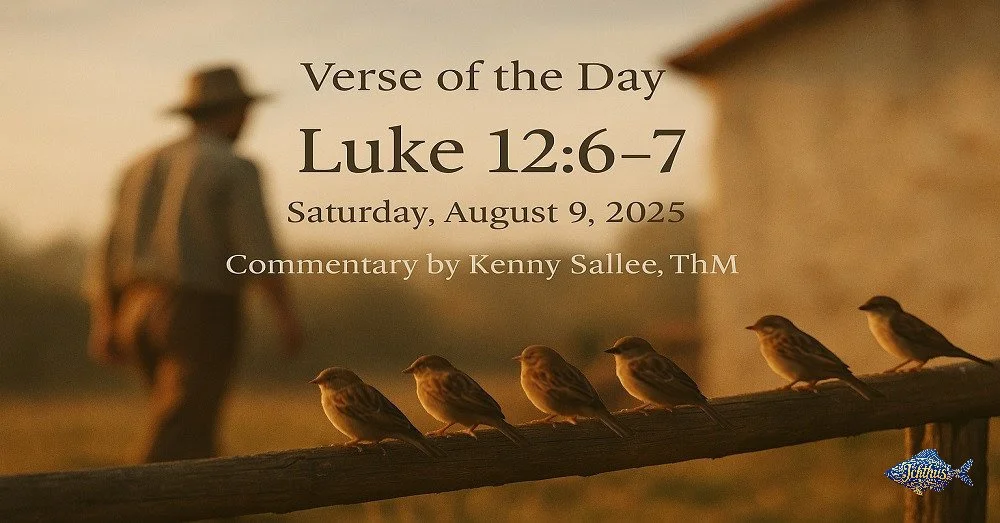
Verse of the Day
Saturday, August 9, 2025
Luke 12:6-7
Are not five sparrows sold for two pennies? Yet not one of them is forgotten in God’s sight. But even the hairs of your head are all counted. Do not be afraid; you are of more value than many sparrows.
Introduction
Luke 12:6–7 offers a striking reassurance of God’s intimate care and attentive presence in the lives of believers. Spoken by Jesus in the midst of a discourse on courage, persecution, and faithfulness, these verses draw upon simple imagery to reveal profound theological truths. They reflect a central Lukan theme: that God’s providential concern extends to even the most seemingly insignificant aspects of creation—and especially to those who follow Christ. These words speak directly to the human tendency to fear, reminding disciples that they are seen, known, and valued by God beyond measure.
Commentary
Verse 6: “Are not five sparrows sold for two pennies? Yet not one of them is forgotten in God’s sight.”
In the ancient marketplace, sparrows were inexpensive birds, often used for food by the poor. The Greek word for “penny” is assarion, a small Roman coin of minimal value. Jesus underscores the near-worthlessness of five sparrows in economic terms, yet He reveals that not even one is forgotten by God. The word ἐπιλανθάνομαι (epilanthanomai), translated “forgotten,” conveys intentional mindfulness—indicating that God continually remembers even the most overlooked creatures.
Verse 7: “But even the hairs of your head are all counted. Do not be afraid; you are of more value than many sparrows.”
The transition from sparrows to the human body deepens the intimacy of God's care. The verb ἠριθμημέναι (ērithmēmenai, “are all counted”) expresses exact accounting—nothing escapes divine notice. Jesus concludes with a direct imperative: “Do not be afraid” (μὴ φοβεῖσθε, mē phobeisthe), a command not rooted in denial of danger, but in the assurance of divine attention and worth. The phrase “you are of more value” (διαφέρετε, diapherete) affirms the unique dignity of humanity made in God’s image and loved personally by the Creator.
Understanding the Context
These verses are part of a broader section in Luke 12 in which Jesus prepares His disciples for the challenges of public witness (vv. 1–12). Speaking to a growing crowd, Jesus turns first to His disciples (v. 1), warning them against hypocrisy (especially that of the Pharisees), and urging them to fear God rather than human opposition (v. 5). Luke 12:6–7 serves as a comforting balance to the prior warning: while God has authority and judgment (v. 5), He also possesses tender care and complete knowledge of those who belong to Him.
In Luke’s Gospel, themes of reversal, divine care for the lowly, and fearless discipleship recur frequently (cf. Luke 1:52–53; 6:20–26; 9:23–26). These verses reinforce the idea that following Jesus may entail risk, but never abandonment. The One who calls disciples to bear witness under pressure is the same One who treasures every aspect of their being.
Application for Today
Modern life is often marked by anxiety—fear of rejection, failure, insignificance, or loss. In a world that commodifies human value and prizes status or visibility, Jesus’ words cut through the noise: You are known. You are valued. You are never forgotten. These verses invite Christians to ground their self-worth not in achievement or approval, but in the unwavering love of God.
Moreover, the passage calls the Church to recognize the inherent worth of every individual, especially those whom society overlooks—be they the poor, the elderly, the refugee, or the chronically ill. Jesus’ comparison to sparrows, creatures of minimal market value, reminds us that divine dignity transcends human systems of valuation. For pastoral ministry, this affirms the sacredness of each life and encourages compassionate presence, especially in times of fear or suffering.
Practically, Luke 12:6–7 challenges believers to cultivate spiritual resilience: to face pressures—whether persecution, personal trials, or cultural scorn—not with despair, but with confidence in God’s sustaining knowledge and care.
Reflection
Jesus’ words in Luke 12:6–7 call for more than theological assent; they invite a reorientation of the heart. They suggest that true courage arises not from self-reliance but from being deeply rooted in the knowledge of God’s attentive love. This is not sentimental reassurance, but a robust theology of divine providence: a conviction that even when circumstances appear chaotic or threatening, God is not absent or indifferent.
To embrace this truth is to adopt a posture of trust that can reshape both individual discipleship and communal life. It is to live with the quiet strength that comes from being known—entirely, intricately, and eternally—by the One who formed us. In ministry, this awareness enables leaders to walk with others not from a place of superiority but solidarity, affirming that each person’s story is held within the memory and mercy of God.
Ultimately, Luke 12:6–7 challenges the Church to bear witness not only with words but with lives that embody this fearless trust and radical assurance: that not one sparrow is forgotten, and neither are we.
The Bible texts are from the New Revised Standard Version (NRSV) Bible, copyright © 1989, 1993 the Division of Christian Education of the National Council of the Churches of Christ in the United States of America. Used by permission. All rights reserved. Verse of the Day is a daily inspirational and encouraging Bible verse, extracted from BibleGateway.com. Commentary by Kenny Sallee, ThM.
