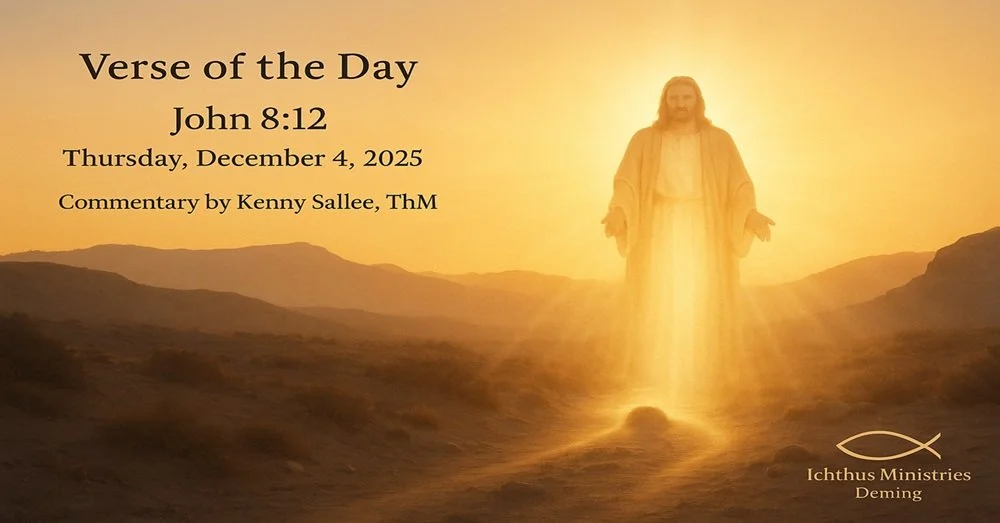
Verse of the Day
Thursday, December 4, 2025
John 8:12
Again Jesus spoke to them, saying, “I am the light of the world. Whoever follows me will never walk in darkness but will have the light of life.”
Introduction
John 8:12 stands as one of the most striking “I am” sayings in the Gospel of John, encapsulating Jesus’ identity and mission through the rich metaphor of light. This declaration situates Jesus not merely as a bearer of illumination but as the very source of divine revelation and life. Within the broader Johannine narrative, light signifies God’s presence breaking into a world shadowed by sin, confusion, and despair. Jesus’ claim therefore carries both theological depth and deeply personal implications for those who seek to follow Him.
Commentary
The verse opens with the solemn formula, “I am,” echoing both the divine name revealed in Exodus 3:14 and the Gospel’s overarching theme of Jesus’ self-revelation. By identifying Himself as “the light of the world,” Jesus speaks to universal human longing for clarity, guidance, truth, and hope. In the biblical tradition, light signifies purity, wisdom, divine glory, and the power that dispels darkness. Here, “darkness” is not merely a metaphor for ignorance but the spiritual condition of separation from God—a state the Gospel frequently associates with unbelief and resistance.
The promise that “Whoever follows me will never walk in darkness” uses discipleship language drawn from the imagery of journeying. To “walk” signifies one’s pattern of life. Jesus’ assurance is therefore not a guarantee of a trouble-free existence but an affirmation that His followers will not be overcome by the disorienting and destructive effects of sin. The phrase “light of life” suggests a light that does more than reveal; it imparts vitality. This is consistent with the Gospel’s earlier claim that Jesus is both life and light (John 1:4). The radiance He gives is not external but transformative, reshaping the believer’s character, vision, and direction.
Understanding the Context
John 8:12 occurs within the context of the Feast of Tabernacles (Sukkot), one of Israel’s major festivals. A key feature of this festival was the nightly illumination of large lampstands in the temple courts, commemorating the pillar of fire that guided Israel in the wilderness. Against this brilliant backdrop, Jesus’ declaration becomes even more dramatic: He is claiming to be the true and greater light, not merely a symbolic reminder of past deliverance but the present embodiment of God’s saving presence.
The surrounding chapters are filled with debates about Jesus’ authority and identity. In John 7, Jesus teaches publicly during the festival, causing division among the people. In John 8, His identity continues to be contested by the religious authorities. The claim “I am the light of the world” therefore serves as a direct answer to their doubts, positioning Jesus as the definitive revelation of God amid misunderstanding and opposition. Thematically, this verse resonates with the Prologue (John 1:1–18), where the arrival of the true Light is described as both a gift and a point of conflict: “The light shines in the darkness, and the darkness did not overcome it.”
Application for Today
For contemporary Christians, Jesus’ words challenge us to evaluate the sources of light by which we attempt to navigate our lives. Modern culture offers countless forms of “illumination”—self-help doctrines, shifting moral frameworks, political ideologies, and personal ambitions—yet none of these dispel darkness in the way Christ does. Following Jesus means consciously allowing His teaching, character, and presence to shape our decisions, relationships, and values.
To “walk in darkness” today may manifest as habits that numb the soul, patterns of dishonesty, destructive anger, or choices made from fear rather than faith. Christ’s light exposes such realities—not to condemn but to heal and redirect. Conversely, receiving the “light of life” enables believers to see themselves, others, and the world with renewed clarity. It leads to compassion in place of indifference, integrity in place of compromise, and hope in place of resignation. Discipleship becomes a journey of continually choosing Christ’s illumination over the shadows that persist in and around us.
Reflection
John 8:12 invites a sober yet hopeful reconsideration of the paths we walk and the lights we trust. It challenges us to recognize that spiritual darkness is not merely an external force but an internal reality that Christ alone can dispel. His claim to be the world’s true light confronts narrow, domesticated visions of Jesus and calls us to see Him as the One who reveals God’s purposes with unmistakable clarity. As we ponder this verse, we are encouraged to consider how Christ’s light might reshape our understanding, our daily choices, and the way we engage with a world still longing for illumination.
The Bible texts are from the New Revised Standard Version (NRSV) Bible, copyright © 1989, 1993 the Division of Christian Education of the National Council of the Churches of Christ in the United States of America. Used by permission. All rights reserved. Verse of the Day is a daily inspirational and encouraging Bible verse, extracted from BibleGateway.com. Commentary by Kenny Sallee, ThM.
