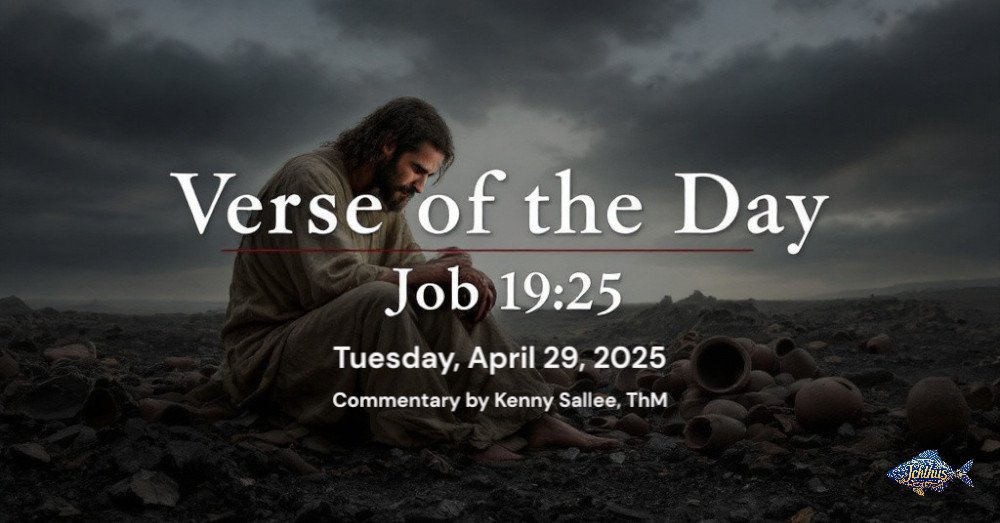
Verse of the Day
Tuesday, April 29, 2025
Job 19:25
For I know that my Redeemer lives, and that at the last he will stand upon the earth.
Introduction
Few verses in the Old Testament resonate with as much enduring hope and theological depth as Job 19:25. Uttered amid despair and isolation, Job’s declaration of faith is both a cry of trust and a foretelling of redemption. These words, often recited at funerals and memorials, testify not only to Job’s confidence in divine justice but also to a glimpse of resurrection hope long before the New Testament era.
Commentary
Job’s bold proclamation, “I know that my Redeemer lives,” introduces a powerful shift in tone. The Hebrew term for “Redeemer” (go’el) carries legal and familial connotations—most commonly used for a kinsman redeemer, a relative responsible for restoring the rights and well-being of a family member. This figure would avenge wrongs, redeem property, or even ransom a relative from slavery.
Job is appealing to a living, personal advocate—one who will vindicate him when human justice fails. His hope is not abstract or wishful; it is rooted in knowledge: “I know that my Redeemer lives.” Despite physical suffering and spiritual torment, Job clings to the belief that his ultimate restoration and justification will come through this divine figure, who will “stand upon the earth” in the end—symbolizing final authority and triumphant judgment.
Understanding the Context
Job 19 is one of the emotional high points of the book. After being misunderstood and accused by his friends—especially Bildad in chapter 18—Job launches a defense. His lament begins with bitterness at the cruelty of others (vv. 1–22), but then crescendos in verses 23–27 with a deeply personal confession of faith.
These verses are extraordinary because they emerge from the deepest pit of despair. Job, stripped of health, wealth, and companionship, expresses a startling confidence in a living Redeemer. Although Job likely did not possess a fully developed doctrine of the afterlife or resurrection, the Spirit inspires a timeless truth—one that Christian theology later connects to the person and work of Jesus Christ, who stands as our Redeemer and final Advocate.
Application for Today
In seasons of suffering, doubt, or injustice, Job 19:25 invites us to anchor our faith not in outcomes, but in a person—the Redeemer who lives. For Christians, this verse points us to Jesus Christ, who not only redeems us from sin but promises to stand with us in every trial and to one day make all things right.
This verse is especially meaningful in times of loss. When earthly answers fall short, and when justice is delayed or denied, we can find strength in Job’s confidence: that God sees, God knows, and God will act. It also reminds believers that resurrection hope is not reserved for the future alone; it animates our lives here and now with courage, faithfulness, and endurance.
Reflection
Job’s words echo through time as a hymn of hope and defiance against despair. They remind us that faith is not the absence of suffering, but the refusal to let suffering obscure the reality of a living, redeeming God. In our personal trials—whether physical, emotional, or spiritual—we can look to Job not only as a model of perseverance but as a prophet of redemption.
Even when we cannot see the end of our story, we can trust the One who stands at the end—and He lives.
The Bible texts are from the New Revised Standard Version (NRSV) Bible, copyright © 1989, 1993 the Division of Christian Education of the National Council of the Churches of Christ in the United States of America. Used by permission. All rights reserved. Verse of the Day is a daily inspirational and encouraging Bible verse extracted from BibleGateway.com. Commentary by Kenny Sallee, ThM.
