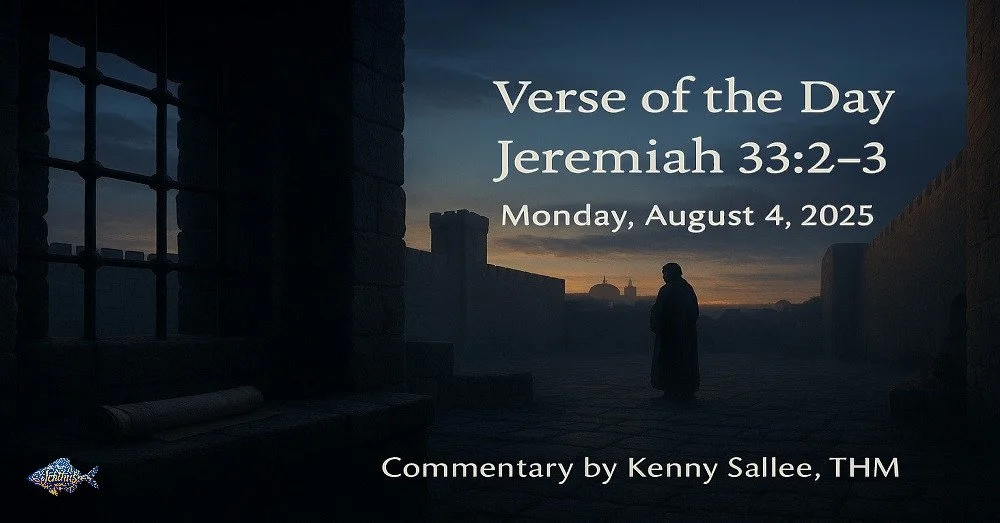
Verse of the Day
Monday, August 4, 2025
Jeremiah 33:2-3
Thus says the Lord who made the earth, the Lord who formed it to establish it—the Lord is his name: Call to me and I will answer you, and will tell you great and hidden things that you have not known.
Introduction
Jeremiah 33:2–3 stands as a striking moment of divine assurance in one of the darkest seasons of Judah’s history. Set amid the turmoil of siege and exile, these verses affirm God's sovereignty, invite open communication, and promise revelatory knowledge. They encapsulate a profound theological truth: even in times of apparent silence and devastation, God remains active, present, and willing to reveal His purposes. The passage unites themes of divine sovereignty, revelation, and hope, offering a dual message of invitation—“Call to me”—and promise—“I will answer you.” As part of Jeremiah’s broader message of restoration, these verses extend beyond their immediate context to encourage all who seek God amidst uncertainty and despair.
Commentary
Verse 2: “Thus says the Lord who made the earth, the Lord who formed it to establish it—the Lord is his name:”
This verse begins with a formal prophetic introduction, reaffirming the identity and authority of the speaker: YHWH, the covenant God of Israel. The threefold declaration—“made,” “formed,” and “established”—emphasizes God’s creative power and intentional design. These verbs echo the language of Genesis 1–2, reinforcing God’s role not only as Creator but also as Sustainer and Orderer of all things. The phrase “the Lord is his name” (Hebrew: YHWH shemo) underscores God's self-revealed identity, anchoring the forthcoming promise in the authority of the One who holds ultimate dominion.
Verse 3: “Call to me and I will answer you, and will tell you great and hidden things that you have not known.”
Here, the imperative “Call to me” (Hebrew: qĕrā’ ēlay) invites personal communication with God—a bold instruction given amid national catastrophe. The promise “I will answer you” is not conditional on Israel’s worthiness but on God’s steadfastness. The phrase “great and hidden things” (Hebrew: gĕdōlōṯ ūḇĕṣūmōṯ) conveys a sense of inaccessible or fortified truths—knowledge previously concealed or too lofty for human discernment. The term batsar (“hidden” or “inaccessible”) can connote military fortifications, suggesting that God's revelations pertain to mysteries beyond human reach, now made accessible by divine initiative. This assurance of unveiled understanding reaffirms God's desire to lead His people beyond despair into renewed insight and purpose.
Understanding the Context
Jeremiah 33:2–3 is part of the so-called Book of Consolation (Jeremiah 30–33), a section that contrasts sharply with much of Jeremiah’s otherwise dire prophetic ministry. These chapters offer a vision of restoration, renewal, and divine faithfulness, even as Jerusalem faces imminent destruction by Babylon. At this moment, Jeremiah is imprisoned (cf. Jer. 33:1), the city is under siege, and national morale is at its lowest. Yet, in the heart of judgment, God speaks hope. The invitation to “call” and the promise of “hidden things” come not from a position of national strength or spiritual triumph but from a posture of defeat, exile, and confinement.
Significantly, this passage anticipates the eventual return from exile, the rebuilding of Jerusalem, and the reestablishment of the covenant community. The larger context of Jeremiah 33 includes messianic hope (vv. 14–16) and covenantal renewal, indicating that God’s purposes extend beyond immediate rescue to long-term redemption.
Application for Today
Modern readers encounter Jeremiah 33:2–3 as a call to active, expectant faith in a God who is still sovereign and communicative. In a culture overwhelmed by information yet starved for wisdom, this passage reminds believers that revelation comes not merely through intellect but through relationship. To “call” upon God implies more than casual inquiry—it demands intentional, persistent seeking grounded in trust.
For Christians today, “great and hidden things” may not refer to esoteric knowledge or mystical experiences but to the unfolding of God’s will amid uncertainty: understanding a season of suffering, discerning a calling, or perceiving the quiet work of grace in daily life. Practical disciplines such as prayer, silence, scripture meditation, and spiritual discernment become avenues through which God speaks and reveals what we “have not known.”
Furthermore, this passage calls for patient trust. The promise of revelation is sure—but not necessarily immediate. In a society conditioned for instant answers, believers are reminded that God’s timing and content of revelation are aligned with His redemptive purposes, not our preferences.
Reflection
Jeremiah 33:2–3 challenges readers to examine their posture toward divine revelation. Are we truly prepared to hear what God might say if we were to call upon Him? Are we open to the possibility that what is “hidden” may confront our assumptions or redirect our plans?
This passage encourages a move from passive belief to active engagement. It affirms that revelation is not reserved for prophets alone, but is available to all who earnestly seek the One who formed the earth and holds all mysteries in His hand. God does not withhold truth to keep us in the dark; He withholds it until we are ready to walk in the light of what is revealed.
Ultimately, Jeremiah 33:2–3 invites a more attentive, responsive way of living—one in which the Christian life is not a monologue of need but a dialogue of discovery. In calling out to the Lord, we risk being changed by the answers we receive.
The Bible texts are from the New Revised Standard Version (NRSV) Bible, copyright © 1989, 1993 the Division of Christian Education of the National Council of the Churches of Christ in the United States of America. Used by permission. All rights reserved. Verse of the Day is a daily inspirational and encouraging Bible verse, extracted from BibleGateway.com. Commentary by Kenny Sallee, ThM.
