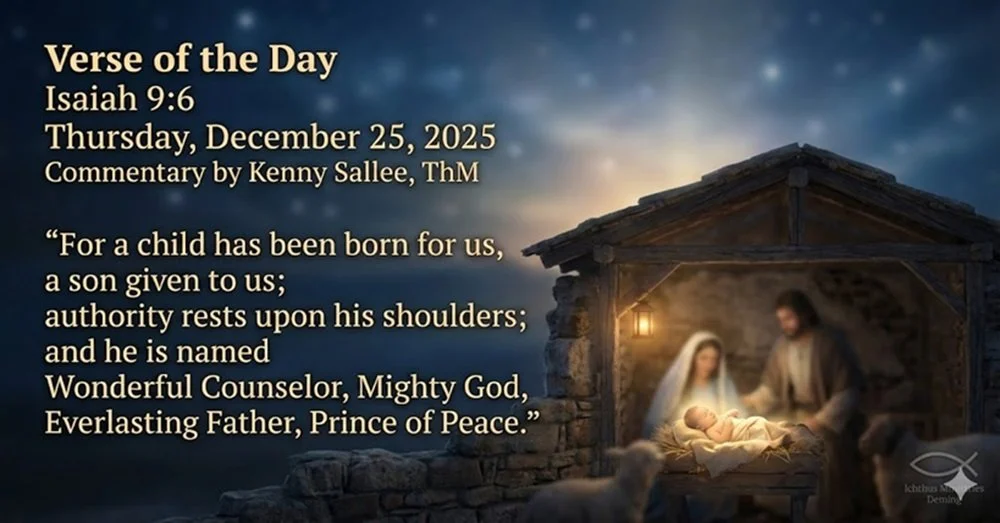
Verse of the Day
Thursday, December 25, 2025
Isaiah 9:6
For a child has been born for us, a son given to us; authority rests upon his shoulders; and he is named Wonderful Counselor, Mighty God, Everlasting Father, Prince of Peace.
Introduction
Isaiah 9:6 stands as one of the towering peaks of Old Testament prophecy, located within the section of Isaiah often called the "Book of Immanuel" (chapters 7–12). Following immediately after a description of gloom and anguish, this verse serves as the theological pivot where the prophet declares the dawn of a "great light" upon people walking in darkness.
In Christian theology, this text is foundational to the seasons of Advent and Christmas. It is not merely a birth announcement of a royal heir in antiquity; it is interpreted as the crystallization of Messianic hope. The verse bridges the gap between human history—the birth of a child—and divine intervention—the bestowal of titles that suggest a character and power far beyond ordinary human capacity. It anchors the Christian claim that God’s answer to human suffering and political chaos is not a system or a philosophy, but a Person.
Commentary
"For a child has been born for us, a son given to us"
The duality here suggests both humanity and gift. The "child born" emphasizes the concrete, historical reality of the Incarnation—a vulnerable entry into the human timeline. The "son given" implies that this figure originates from outside the closed system of human lineage; he is a gift of grace from God to a people who cannot save themselves. The preposition "for us" is crucial; the birth is not a private royal matter but a public benefit for the community.
"Authority rests upon his shoulders"
In the ancient Near East, the shoulder was the place where heavy burdens were carried. Here, the burden is governance. Unlike the "yoke of their burden" mentioned in verse 4 (the oppression of enemies), the government upon this child’s shoulders represents a righteous rule that relieves rather than oppresses. It suggests that he is capable of bearing the weight of the world’s management.
"Wonderful Counselor"
This title combines the concept of a miracle (pele) with that of a strategist (ya’ats). It suggests a ruler whose wisdom goes beyond human statecraft. He does not rely on political triangulation or manipulation; his counsel is supernatural, eliciting awe and wonder. He creates a way where there is no way.
"Mighty God"
Perhaps the most striking title (El Gibbor), this attributes divine warrior status to the child. While some historical interpreters viewed this as a hyperbolic reference to a king acting as God's representative, Christian theology sees this as an explicit pointer to the divinity of Christ. The "child" is not just a representative; he possesses the very might of the Divine Warrior who fights on behalf of his people.
"Everlasting Father"
This title can be confusing in Trinitarian theology, but in the context of Isaiah, it refers to the character of the king's rule, not his place in the Trinity. He is the "Father of Eternity" or the "Father of the Age to Come." It signifies a benevolent protector—a ruler who treats his subjects with the care, provision, and protection of a father, forever. His reign is not a temporary administration but a permanent reality.
"Prince of Peace"
Finally, the ruler is defined by Shalom. He is the Sar Shalom. This is not merely the absence of war (a ceasefire), but the presence of wholeness, flourishing, and cosmic order. In a world accustomed to achieving peace through the sword, this Prince establishes peace through the integrity of his rule.
Understanding the Context
To fully grasp the shock of this prophecy, one must understand the darkness in which it was spoken. Isaiah prophesied during the 8th century BCE, a time of terrifying geopolitical instability. The Neo-Assyrian Empire was rising, threatening to swallow the small nations of Israel and Judah. King Ahaz of Judah was paralyzed by fear, tempted to make disastrous alliances with foreign powers to survive.
Against this backdrop of fear and failed leadership, Isaiah utilizes the language of a "Royal Accession Psalm." In the ancient Near East, when a new king was crowned, high hopes were projected onto him. He was often given throne names signifying his adoption by the deity and his mandate to rule.
However, Isaiah’s language transcends the typical coronation hymn. While it may have had an immediate historical referent (perhaps the birth of the faithful King Hezekiah), the extravagance of the titles—particularly "Mighty God"—explodes the boundaries of any earthly monarch. Isaiah was looking through the lens of the immediate crisis to a future, ultimate King who would finally break the rod of the oppressor, not through military might, but through a new kind of divine governance.
Application for Today
Redefining Power
In a modern context obsessed with coercive power and political leverage, Isaiah 9:6 offers a counter-narrative. True authority is not found in the ability to dominate, but in the capacity to bear the burden of others ("upon his shoulders") and to govern with paternal care. It challenges believers to look for leadership that serves rather than conquers.
The Source of Peace
We often seek peace through control—controlling our finances, our environment, or our relationships. The title "Prince of Peace" reminds us that true Shalom is a gift to be received, not a status to be manufactured. It invites Christians to abandon the anxiety of self-preservation and trust in the One who governs history.
Wisdom in Complexity
Life often presents dilemmas that human logic cannot solve. The "Wonderful Counselor" invites us to seek a wisdom that is not linear or pragmatic but is, literally, "full of wonder." It encourages a reliance on prayer and the Holy Spirit when navigating the complexities of modern ethics, family life, and vocation.
Reflection
Consider the paradox presented in this ancient text: the solution to the world’s crushing weight is a child. We often wait for a change in circumstances, a shift in the economy, or a new political strategy to save us. Yet, Isaiah directs our gaze to a person—a son given.
Reflect on the titles given to this child. Where in your life do you need a Counselor to break through confusion? In what area do you feel weak and require a Mighty God? Where do you feel orphaned or abandoned, needing an Everlasting Father? And where is the chaos so loud that only the Prince of Peace can silence it?
The government is on his shoulders so that it does not have to be on yours. The invitation is not to understand how infinite power can reside in a finite child, but to rest in the authority He carries. He has already been born; the son has already been given. The question that remains is whether we are willing to relinquish our own attempts at governance and trust His rule.
The Bible texts are from the New Revised Standard Version (NRSV) Bible, copyright © 1989, 1993 the Division of Christian Education of the National Council of the Churches of Christ in the United States of America. Used by permission. All rights reserved. Verse of the Day is a daily inspirational and encouraging Bible verse, extracted from BibleGateway.com. Commentary by Kenny Sallee, ThM.
