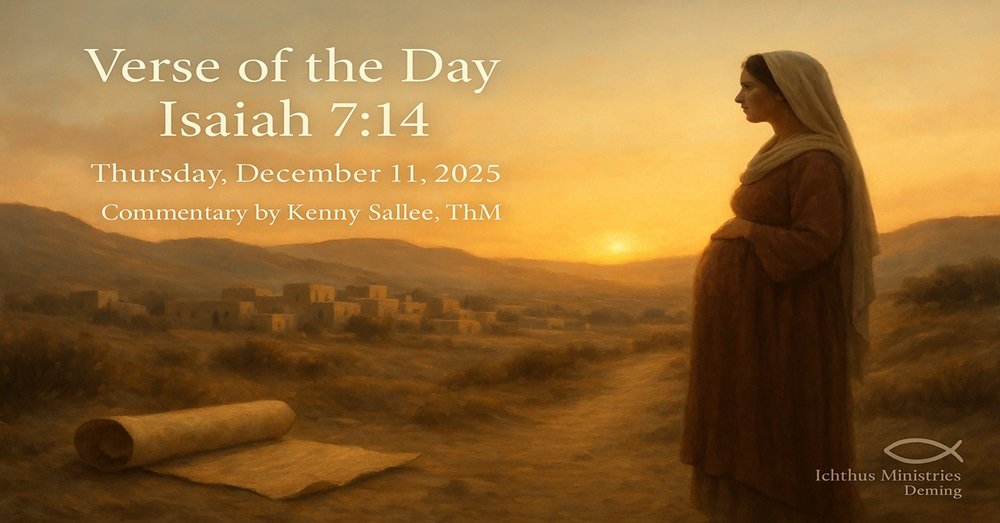
Verse of the Day
Thursday, December 11, 2025
Isaiah 7:14
Therefore the LORD himself will give you a sign. Look, the young woman is with child and shall bear a son, and shall name him Immanuel.
Introduction
Isaiah 7:14 stands as one of the most discussed and theologically weighted passages in the prophetic literature. Situated within a moment of national crisis for Judah, the verse offers a divine promise of reassurance and presence. For ancient Israel, it addressed immediate fears about political instability; for Christians, it also points forward to the incarnation of Jesus Christ, whose birth embodies God’s ultimate act of dwelling among His people. The enduring importance of this verse lies in its dual layers of meaning—its capacity to speak both to its original historical situation and to the unfolding story of salvation.
Commentary
“Therefore the Lord himself will give you a sign.”
God initiates this sign directly, emphasizing divine sovereignty and assurance. King Ahaz had refused to ask for a sign (Isaiah 7:12), cloaking his unbelief in false piety. In response, God provides a sign anyway, demonstrating that His purposes do not rely on human initiative or faithfulness.
“Look, the young woman is with child…”
The Hebrew term almah traditionally means a young woman of marriageable age. It typically implies virginity, though not with the precision of the Hebrew betulah. In the original context, almah likely referred to a contemporary woman known to the court or the prophet—someone whose pregnancy would serve as a time marker for the unfolding events. Christian interpreters, guided by the Septuagint’s rendering of almah as parthenos (“virgin”), understand this phrase as anticipating the virginal conception of Jesus.
“…and shall bear a son…”
The birth of the child indicates continuity and hope. In Isaiah’s day, children represented future stability—an assurance that Judah would survive despite the threats surrounding it. In Christian interpretation, the birth foreshadows the incarnation, in which God decisively enters human history.
“…and shall name him Immanuel.”
The name Immanuel means “God with us.” For King Ahaz and Judah, it was a declaration that God had not abandoned His covenant people despite the looming danger of foreign powers. For Christians, the name reaches its fullest meaning in Jesus Christ, whose life, death, and resurrection embody the very presence of God among humanity.
Understanding the Context
Isaiah 7 is set during the Syro-Ephraimite crisis (circa 734–732 BCE), when the northern kingdom of Israel (Ephraim) and the kingdom of Aram (Syria) attempted to force Judah into an anti-Assyrian alliance. King Ahaz of Judah faced intense pressure, both politically and militarily, and was tempted to seek protection through an alliance with Assyria rather than trusting God.
Isaiah’s prophetic role was to call Ahaz back to trust in God’s promises. The sign of the child named Immanuel served as a concrete assurance: before the child grew old enough to discern right from wrong, the threat from the two enemy kings would disappear (Isaiah 7:16). The sign was thus both a message of judgment on Judah’s enemies and a call for Ahaz to rely on God rather than political maneuvering.
In the New Testament, Matthew 1:22–23 cites Isaiah 7:14 explicitly, applying it to the birth of Jesus. Matthew interprets Jesus’ virgin birth as the ultimate fulfillment of the Immanuel sign, extending the meaning of “God with us” far beyond its immediate historical horizon. While the original prophecy spoke to Ahaz’s crisis, Matthew sees in its language a deeper, divinely orchestrated pattern that culminates in the incarnation.
Application for Today
Isaiah 7:14 speaks powerfully into the lives of modern believers by reminding us that God is faithful even when circumstances feel overwhelming. Just as Judah faced political uncertainty, we face uncertainties in our personal, communal, and global contexts. The sign of Immanuel assures us that God’s presence is not theoretical but tangible, even in moments when our faith falters.
This passage also encourages trust in God’s timing. The birth of a child—something that unfolds slowly—reminds us that divine solutions often develop over time rather than instantaneously. Isaiah’s audience had to wait and watch; so do we. Yet the assurance remains: God is with us in every season, guiding, sustaining, and fulfilling His purposes.
Finally, the dual meaning of Isaiah 7:14 invites believers to hold together the historical and the theological. We honor the integrity of the original context while also embracing the richness of its Christological fulfillment. This teaches us to read Scripture with both reverence and expectation.
Reflection
Isaiah’s promise of “Immanuel—God with us” challenges us to rethink what divine presence truly means. It is not merely a comfort in difficulty but a transformative reality that reshapes how we see the world. The sign given to Ahaz pointed to stability amid crisis; the sign fulfilled in Christ points to the profound truth that God chooses to dwell with humanity, not from a distance but from within our lived experience. This awareness invites us to live with deeper confidence, greater hope, and renewed attentiveness to the ways God continues to reveal His presence in the ordinary rhythms of life.
The Bible texts are from the New Revised Standard Version (NRSV) Bible, copyright © 1989, 1993 the Division of Christian Education of the National Council of the Churches of Christ in the United States of America. Used by permission. All rights reserved. Verse of the Day is a daily inspirational and encouraging Bible verse, extracted from BibleGateway.com. Commentary by Kenny Sallee, ThM.
