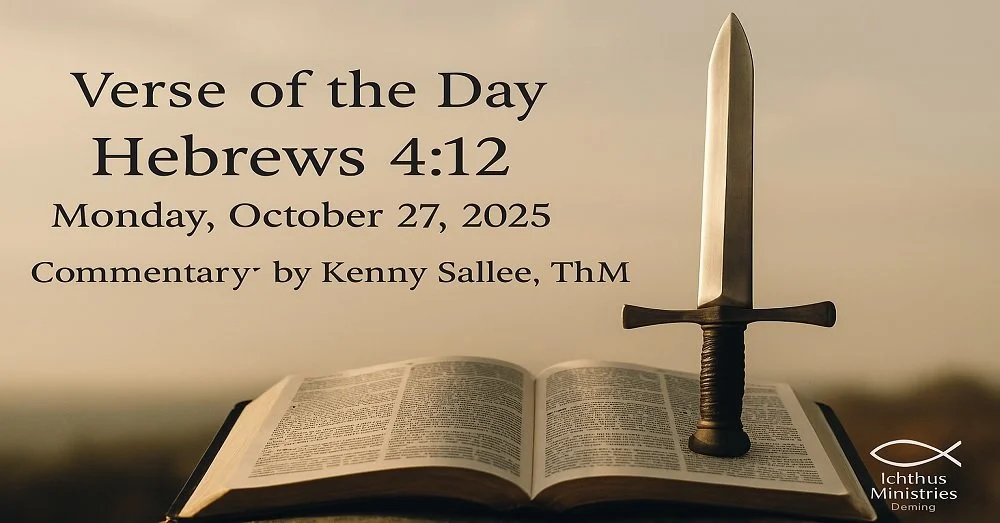
Verse of the Day
Monday, October 27, 2025
Hebrews 4:12
Indeed, the word of God is living and active, sharper than any two-edged sword, piercing until it divides soul from spirit, joints from marrow; it is able to judge the thoughts and intentions of the heart.
Introduction
Hebrews 4:12 stands as one of the most penetrating and frequently cited verses in the epistle, offering a vivid portrait of the dynamic power of God’s Word. Positioned at the intersection of exhortation and warning, this verse encapsulates the author’s conviction that divine revelation is not static but alive—an instrument of judgment and transformation. Within the theological architecture of Hebrews, which seeks to present Christ as the ultimate revelation and mediator of the new covenant, this statement underscores that God’s Word, whether spoken, written, or incarnate in Christ, operates with living energy and moral precision. Its enduring weight lies in its portrayal of Scripture as an active participant in the divine economy—one that both comforts and convicts, exposing the deepest truths of the human condition.
Commentary
“The word of God is living and active”
The Greek terms zōn (“living”) and energēs (“active”) depict vitality and efficacy. Unlike mere human speech, the Word of God is not inert or confined to parchment; it possesses intrinsic life and power. This aligns with the biblical motif of God’s speech as creative and sustaining (cf. Genesis 1; John 1:1–4). The divine Word does not merely describe reality—it enacts it.
“Sharper than any two-edged sword”
The two-edged sword was the most efficient weapon of its time, cutting both ways with precision. The imagery suggests a Word that penetrates every layer of defense and self-deception. Its sharpness conveys discernment and finality, revealing both grace and judgment within the same movement.
“Piercing until it divides soul from spirit, joints from marrow”
These pairings are not meant to dissect human anatomy or metaphysics but to express total penetration. The Word of God reaches the innermost core of being—distinguishing between what is psychical (psuchē) and spiritual (pneuma), between surface motives and true intentions. Like a surgeon’s scalpel, it exposes what lies hidden beneath appearances.
“Able to judge the thoughts and intentions of the heart”
The verb kritikos (from which we derive “critical”) emphasizes that God’s Word acts as judge, not merely as observer. It evaluates human motives, revealing moral and spiritual integrity—or its absence. This judgment is not punitive by nature but diagnostic, meant to bring healing through truth.
Understanding the Context
Within Hebrews 4, the verse functions as both a conclusion and a warning. The chapter’s dominant theme is rest—God’s promised rest, which Israel failed to enter because of unbelief (Hebrews 4:1–11). The author urges readers to respond faithfully and not repeat Israel’s disobedience. Immediately following the call to diligence in faith, Hebrews 4:12–13 reminds the audience that nothing escapes the scrutiny of God’s Word. It connects divine speech with divine omniscience: the same Word that promises rest also exposes unbelief.
The verse also resonates with Old Testament imagery. The “two-edged sword” echoes Isaiah 49:2 and Wisdom 18:15–16, where God’s Word is depicted as a powerful agent of judgment and deliverance. The implicit warning is that Israel heard God’s Word in the wilderness but did not let it penetrate their hearts. Thus, the writer exhorts his hearers to allow the living Word to perform its work—to convict, cleanse, and guide them toward faithful obedience and divine rest.
Application for Today
For modern believers, Hebrews 4:12 serves as both encouragement and challenge. It confronts the contemporary tendency to domesticate Scripture—to treat it as a static text subject to private interpretation rather than a living voice of divine authority. The verse reminds the church that the Word still speaks, cutting through layers of rationalization and self-justification. When Scripture is engaged with openness and humility, it becomes a mirror revealing our truest selves, not as we wish to appear but as we are before God.
In a culture where opinions often substitute for truth, this verse calls Christians to a renewed reverence for the discernment of God’s Word. It is through this living Word that moral clarity is restored, spiritual lethargy is pierced, and transformation begins. The same Word that wounds also heals—disrupting complacency so that faith may deepen and obedience may flourish.
Reflection
Hebrews 4:12 invites us to recognize that God’s Word is not a relic of the past but the pulse of divine life in the present. It engages not only our intellect but our entire being, uncovering what we conceal even from ourselves. In an age saturated with words that echo and fade, the Word of God remains incisive and eternal—never outdated, never neutral. It confronts every generation with the question of authenticity: Are we merely hearers, or are we transformed by what we hear? The living Word still searches, divides, and renews, reminding us that to encounter it is to stand before the very presence of God who speaks, reveals, and redeems.
The Bible texts are from the New Revised Standard Version (NRSV) Bible, copyright © 1989, 1993 the Division of Christian Education of the National Council of the Churches of Christ in the United States of America. Used by permission. All rights reserved. Verse of the Day is a daily inspirational and encouraging Bible verse, extracted from BibleGateway.com. Commentary by Kenny Sallee, ThM.
