Verse of the Day
Monday, January 12, 2026
Galatians 3:26-28
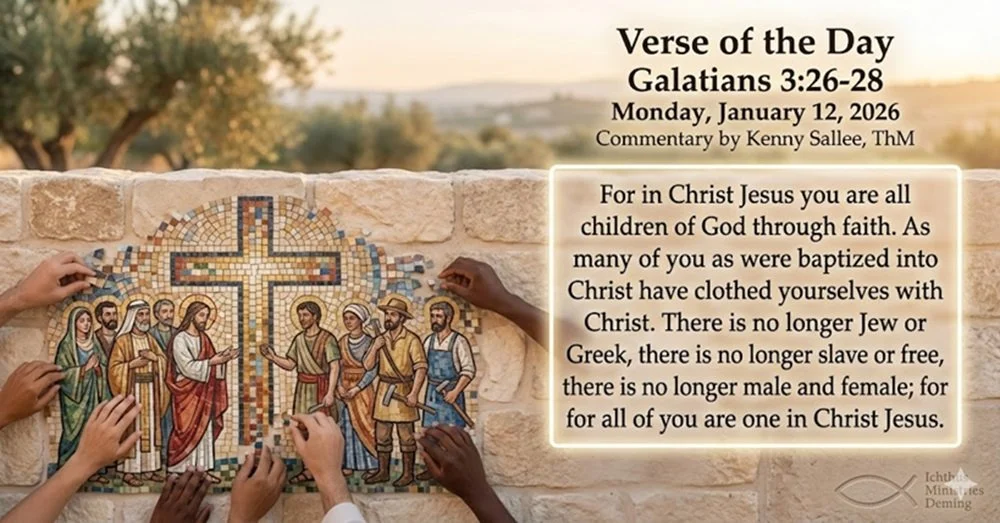
For in Christ Jesus you are all children of God through faith. As many of you as were baptized into Christ have clothed yourselves with Christ. There is no longer Jew or Greek, there is no longer slave or free, there is no longer male and female; for all of you are one in Christ Jesus.
Introduction
Few passages in the New Testament articulate the radical nature of Christian identity as powerfully as Galatians 3:26–28. Often described as the "Magna Carta of Christian liberty," this text serves as a theological pivot point in Paul’s letter, moving the argument from the constraints of the Mosaic Law to the expansive freedom found in the Gospel. The central theme here is unity—not a unity achieved through human consensus or cultural assimilation, but a profound ontological unity forged through baptism and faith. For the believer, this passage redefines belonging. It declares that one’s primary status is no longer determined by ethnicity, social class, or gender, but by being incorporated into the life of Jesus Christ. It is a summons to view ourselves and one another through the lens of a shared, divine parentage.
Commentary
Verse 26: The Status of Sonship
"For in Christ Jesus you are all children of God through faith."
Paul begins with a sweeping assertion of status: believers are "children of God" (Greek: huioi, literally "sons," often translated "children" to signify heirs). In the ancient world, and specifically under the Roman legal systems and Jewish tradition, "sonship" carried the specific weight of inheritance rights and legal standing. By applying this title to "all" believers—Gentiles included—Paul is democratizing the spiritual inheritance that was previously viewed as the exclusive domain of Israel. The mechanism for this status change is "faith" (pistis), not adherence to the Law. It is being "in Christ Jesus" that secures this familial bond with the Creator.
Verse 27: Baptismal Identity
"As many of you as were baptized into Christ have clothed yourselves with Christ."
Here, Paul connects the internal reality of faith with the external rite of baptism. The imagery used is vivid: "clothed yourselves" comes from the Greek verb enduo, meaning to put on a garment. In antiquity, a change of clothes often signified a change of status or role. By entering the waters of baptism, the believer symbolically and spiritually "puts on" Christ like a garment. This suggests that when God looks at the believer, He sees the righteousness and character of His own Son. This "clothing" covers the old markers of identity and status, providing a new, primary uniform that signals belonging to the messianic community.
Verse 28: The Transcending of Categories
"There is no longer Jew or Greek, there is no longer slave or free, there is no longer male and female; for all of you are one in Christ Jesus."
This verse contains three pairs of opposites that represent the fundamental divides of the ancient world:
Jew or Greek: The religious and ethnic divide.
Slave or Free: The social and economic divide.
Male and Female: The gender divide.
Paul declares that these distinctions—while they may still exist in the physical realm—carry no weight in terms of spiritual standing or access to God. The phrase "male and female" echoes the creation language of Genesis 1:27, suggesting that in Christ, there is a new creation where the hierarchy and division introduced by the Fall are being undone. The conclusion, "for all of you are one," emphasizes a corporate solidarity. The church is not merely a collection of diverse individuals, but a single organic entity in Christ.
Understanding the Context
To fully appreciate the gravity of these verses, one must understand the crisis in Galatia. Paul was writing to a community destabilized by the "Judaizers"—teachers who insisted that Gentile converts must be circumcised and observe the Mosaic Law to be fully acceptable to God. They argued that faith in Christ was the entry point, but obedience to the Law was the maintenance plan for salvation.
In Galatians 3, Paul counters this by contrasting the Law with the Promise. He describes the Law as a paidagogos (a disciplinarian or guardian) intended to supervise God’s people only until Christ came. Now that Christ has arrived, the era of the guardian is over.
Historically, this was a revolutionary argument. The ancient world was strictly stratified; one’s worth was almost entirely determined by birth, citizenship, and class. By arguing that a Gentile slave had the exact same spiritual inheritance as a Jewish free male, Paul was dismantling the social architecture of his day. He asserts that the Law served a temporary purpose, but the promise given to Abraham—that through his seed all nations would be blessed—is fulfilled in Christ. Therefore, those who belong to Christ are the true heirs of Abraham, regardless of their biological lineage.
Application for Today
The theological assertion that "we are one in Christ" poses a rigorous challenge to the contemporary Church. While we no longer debate circumcision, the temptation to create a two-tiered system of Christianity remains.
1. Identity Politics and Ecclesiology: In a world increasingly polarized by identity politics, this text reminds us that our primary identity is baptismal. While our ethnic, political, or social backgrounds inform our experience, they must not erect barriers to fellowship. The Church is called to be a counter-cultural community where the CEO and the hourly worker, the native and the immigrant, stand as spiritual equals before the Eucharist.
2. Radical Inclusion: Paul’s dismantling of the Jew/Greek binary challenges us to examine where we draw lines of exclusion today. Are there cultural or socio-economic groups that are implicitly made to feel like "second-class" Christians in our communities? True discipleship involves actively dismantling barriers that prevent full participation in the body of Christ.
3. The Witness of Unity: In a fragmented society, a unified Church is a powerful apologetic. When the world sees diverse groups of people loving one another and working together solely because of their common allegiance to Jesus, the Gospel is made visible. We are called to demonstrate that unity does not mean uniformity, but rather a harmony of diverse members "clothed" in the same Lord.
Reflection
To be clothed in Christ is to inhabit a reality where the walls we build to protect our egos and identities are rendered obsolete. We often cling to our distinctions—our titles, our heritage, our gender, our achievements—because they tell us who we are and where we fit in the hierarchy of the world. They provide a sense of safety and definition.
But Paul invites us into a more dangerous and beautiful safety: the safety of being known solely as a child of God. Imagine a community where the first thing seen is not the color of skin, the cut of the suit, or the accent of the voice, but the shimmer of Christ’s own character draped over a human life. This is not a blindness to our God-given diversity, but a vision that sees through the temporary to the eternal.
To "be one in Christ Jesus" is to acknowledge that the person standing across from us—regardless of how different they appear—possesses the same royal dignity and the same divine inheritance as we do. It is to realize that in the economy of grace, there is no scarcity, only the abundance of a Father who has enough love to make heirs of us all.
The Bible texts are from the New Revised Standard Version (NRSV) Bible, copyright © 1989, 1993 the Division of Christian Education of the National Council of the Churches of Christ in the United States of America. Used by permission. All rights reserved. Verse of the Day is a daily inspirational and encouraging Bible verse, extracted from BibleGateway.com. Commentary by Kenny Sallee, ThM.
