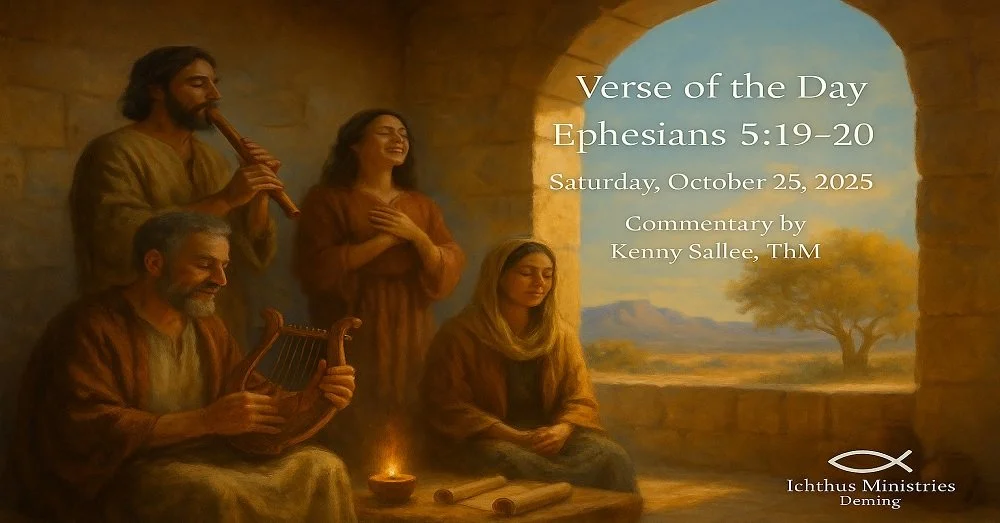
Verse of the Day
Saturday, October 25, 2025
Ephesians 5:19-20
As you sing psalms and hymns and spiritual songs among yourselves, singing and making melody to the Lord in your hearts, giving thanks to God the Father at all times and for everything in the name of our Lord Jesus Christ.
Introduction
In this passage, Paul encourages believers to live in the fullness of the Holy Spirit, expressing their faith through worship and gratitude. These verses form part of his broader exhortation for Christians to walk wisely and live as children of light, contrasting the life of the Spirit with the empty pleasures of the world. Here, Paul presents worship not merely as an activity within the church, but as a way of life—an overflow of joy and thanksgiving that springs from a heart transformed by God’s grace. Singing, thanksgiving, and spiritual harmony are not optional acts but natural expressions of a Spirit-filled life.
Commentary
Paul’s language in verses 19–20 draws from both Jewish and Greco-Roman traditions of song as a form of communal identity and devotion. The terms psalmois, hymnois, and odais pneumatikais—“psalms,” “hymns,” and “spiritual songs”—refer to the variety of expressions within Christian worship.
“Psalms” likely alludes to the Old Testament psalter, used in both temple and synagogue worship, emphasizing the continuity of Christian praise with Israel’s heritage.
“Hymns” were compositions directed specifically to Christ and the Father, celebrating salvation and divine majesty.
“Spiritual songs” (odais pneumatikais) suggests spontaneous songs inspired by the Spirit, personal or communal outpourings of faith.
The phrase “making melody to the Lord in your hearts” (psallontes tē kardia hymōn tō Kyriō) deepens the meaning of worship by shifting the focus from outward performance to inward sincerity. The verb psallō originally meant to pluck or play a stringed instrument, but here it implies that the believer’s heart itself becomes the instrument of praise. This internalization of worship underscores that true music to God arises not from the skill of the singer but from the authenticity of the soul.
The command to “give thanks... at all times and for everything” (eucharistountes pantote hyper pantōn) reflects the Greek root eucharistia, meaning gratitude. Paul is not advocating naïve acceptance of hardship but a mature faith that recognizes God’s providence in all circumstances. Thanksgiving, offered “in the name of our Lord Jesus Christ,” signifies both the authority and the mediation of Christ in our relationship with the Father.
Understanding the Context
Ephesians 5 belongs to Paul’s larger exhortation section (4:17–6:9), in which he contrasts the old life of sin with the new life in Christ. Just prior to this passage, Paul warns against drunkenness and moral excess (5:18), urging instead that believers “be filled with the Spirit.” The verses that follow (5:19–20) illustrate what such Spirit-filled living looks like—communal worship, inward joy, and continual gratitude.
In the Greco-Roman world, public festivals often involved drunken revelry and pagan songs to idols. Paul deliberately contrasts this with Christian gatherings centered on sacred song and thanksgiving. The Christian community’s music becomes a testimony to a new kind of joy—one not dependent on intoxication or circumstance, but on the indwelling presence of God. In this sense, the passage reflects both ethical instruction and liturgical theology: the Spirit transforms daily conduct and redefines the believer’s concept of celebration and fulfillment.
Application for Today
For contemporary believers, Ephesians 5:19–20 offers a blueprint for Spirit-filled living rooted in gratitude, authenticity, and community. In an age where worship can easily become performance-oriented or consumer-driven, Paul’s words remind the church that true worship begins in the heart. Whether through traditional hymns, modern praise, or quiet contemplation, what matters is the sincerity of thanksgiving and the awareness of God’s presence.
Gratitude “at all times and for everything” challenges the modern tendency toward complaint and self-focus. It calls Christians to a posture of trust—seeing God’s hand in both joy and trial. Within the church, this kind of gratitude fosters unity and mutual encouragement, as believers “sing among themselves,” nurturing one another’s faith through shared expression of praise. The passage also invites individuals to make every aspect of life an offering of worship, turning daily work, relationships, and service into melodies of thanksgiving that honor Christ.
Reflection
Ephesians 5:19–20 portrays the Christian life as a symphony of praise, gratitude, and divine harmony. To “make melody in the heart” is to live with an inner rhythm shaped by the Holy Spirit—one that resounds with joy even amid silence or struggle. Such a life transforms ordinary moments into sacred acts of thanksgiving. Paul’s vision of worship transcends music or ritual; it is the continual offering of a heart attuned to God’s grace. In living this way, believers become instruments of divine melody—echoing the song of redemption that began at Calvary and continues in every soul that gives thanks in the name of Christ.
The Bible texts are from the New Revised Standard Version (NRSV) Bible, copyright © 1989, 1993 the Division of Christian Education of the National Council of the Churches of Christ in the United States of America. Used by permission. All rights reserved. Verse of the Day is a daily inspirational and encouraging Bible verse, extracted from BibleGateway.com. Commentary by Kenny Sallee, ThM.
