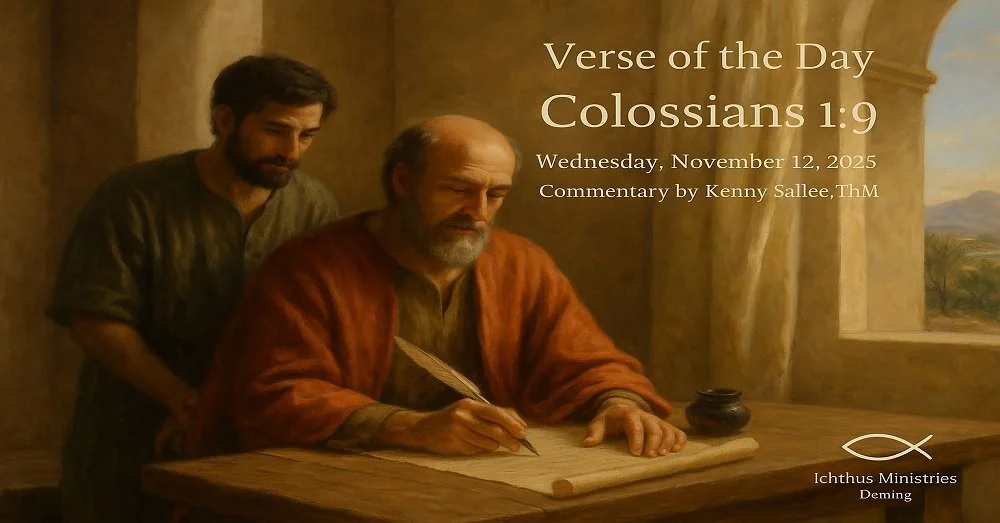
Verse of the Day
Wednesday, November 12, 2025
Colossians 1:9
For this reason, since the day we heard it, we have not ceased praying for you and asking that you may be filled with the knowledge of God’s will in all spiritual wisdom and understanding.
Introduction
Colossians 1:9 marks the beginning of Paul’s intercessory prayer for the believers in Colossae—a prayer that sets the spiritual tone for the entire epistle. Having commended their faith and love (1:3–8), Paul now expresses his continuous desire that they grow in spiritual discernment and knowledge of God’s will. This verse captures a vital theme of Christian maturity: understanding and living out God’s will through the illumination of the Holy Spirit. Paul’s language reflects a concern that the Colossian believers, amid competing philosophies and cultural influences, anchor their faith not in human wisdom but in divine revelation. The verse thus encapsulates the tension between worldly knowledge and spiritual understanding, inviting believers to pursue wisdom that flows from God’s Spirit and leads to fruitful living.
Commentary
The Greek text of Colossians 1:9 provides rich insight into Paul’s theological intent. The phrase “we have not ceased praying for you” (οὐ παυόμεθα προσευχόμενοι) emphasizes ongoing, habitual intercession—a mark of Paul’s pastoral heart. The verb plēroō (πληρωθῆτε, “may be filled”) conveys a sense of being fully permeated or completed, suggesting not mere intellectual comprehension but a transformation of the whole person by divine truth.
Paul prays that believers be filled with “the knowledge of God’s will” (epignōsis tou thelēmatos autou). The term epignōsis (ἐπίγνωσις) denotes not superficial awareness but deep, relational knowledge that arises from communion with God. This is distinct from gnōsis (γνῶσις), which can imply general knowledge; epignōsis is experiential and moral, shaping the believer’s conduct and affections.
The qualifying phrase “in all spiritual wisdom and understanding” (ἐν πάσῃ σοφίᾳ καὶ συνέσει πνευματικῇ) further clarifies Paul’s meaning. Sophia (σοφία) refers to divine insight—wisdom rooted in God’s revelation—while synesis (σύνεσις) emphasizes discernment, the capacity to apply wisdom in specific situations. By adding pneumatikē (πνευματικῇ, “spiritual”), Paul anchors both wisdom and understanding in the work of the Holy Spirit rather than in human speculation or philosophical reasoning. This distinction was vital for a community threatened by teachings that exalted esoteric “knowledge” over faith in Christ.
Understanding the Context
The church at Colossae, a small city in the Lycus Valley of Asia Minor, faced significant theological and cultural pressures. Situated along trade routes, the city was a crossroads of ideas—Greek philosophy, Eastern mysticism, and Jewish legalism all mingled in its intellectual climate. The so-called “Colossian heresy” appears to have promoted a syncretistic blend of angel worship, ascetic practices, and claims of secret wisdom, undermining the supremacy of Christ (cf. Col. 2:8, 16–23).
Paul, writing from prison and having never personally visited the Colossians, addresses them through the report of Epaphras, their founder (1:7–8). His prayer in 1:9 directly counters the allure of false “knowledge” by grounding true wisdom in God’s will revealed through Christ. Instead of seeking mystical insight or human philosophy, Paul urges believers to be filled with understanding that is both spiritual and practical—knowledge that bears fruit in righteous living (1:10). The apostle’s strategy is pastoral and theological: he prays that their understanding of God’s will will inoculate them against doctrinal confusion and moral compromise.
Application for Today
Paul’s prayer remains profoundly relevant to the modern church. In an age saturated with information but starved for wisdom, believers often struggle to discern God’s will amid the noise of competing voices—cultural, political, or even religious. Colossians 1:9 invites Christians to pursue a deeper, Spirit-led comprehension of God’s purposes, not as an abstract concept but as a guide for daily living.
Practically, this means cultivating habits that open the heart to divine wisdom—immersing oneself in Scripture, engaging in communal discernment, and maintaining a posture of prayerful attentiveness. True epignōsis is not acquired through study alone but through relationship; as believers yield to the Holy Spirit, they grow in insight that transforms conduct. Churches, too, can embody this wisdom by fostering communities where spiritual understanding is valued above mere opinion or tradition—spaces where faith seeks understanding in the light of Christ.
Reflection
Colossians 1:9 challenges every believer to consider what fills the mind and shapes the heart. Knowledge alone, detached from the Spirit, can lead to pride or confusion, but knowledge illuminated by divine wisdom produces humility, clarity, and fruitfulness. Paul’s prayer reminds us that spiritual maturity is not measured by the amount we know, but by how deeply God’s will permeates our being and directs our choices. In a world eager to define truth on its own terms, this verse calls us to anchor our discernment in the unchanging wisdom of God—wisdom that enlightens the mind, steadies the heart, and equips us to live faithfully in Christ.
The Bible texts are from the New Revised Standard Version (NRSV) Bible, copyright © 1989, 1993 the Division of Christian Education of the National Council of the Churches of Christ in the United States of America. Used by permission. All rights reserved. Verse of the Day is a daily inspirational and encouraging Bible verse, extracted from BibleGateway.com. Commentary by Kenny Sallee, ThM.
