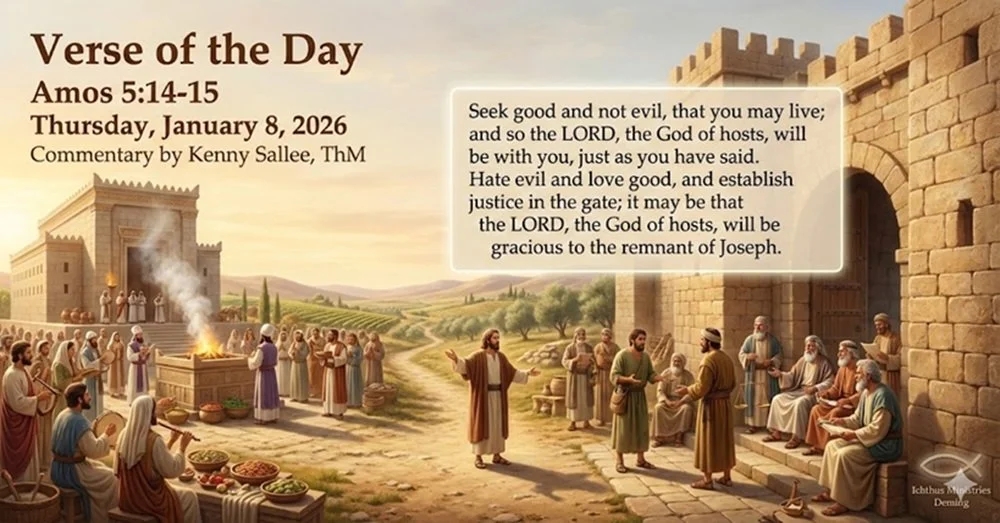
Verse of the Day
Thursday, January 8, 2026
Amos 5:14-15
Seek good and not evil, that you may live; and so the LORD, the God of hosts, will be with you, just as you have said. Hate evil and love good, and establish justice in the gate; it may be that the LORD, the God of hosts, will be gracious to the remnant of Joseph.
Introduction
The book of Amos is often characterized by its roaring lion, a metaphor for a God whose patience has been exhausted by the hypocrisy of His people. The central tension driving this prophetic work is the violent incompatibility between rigorous ritual piety and rampant social injustice. To the ancient Israelites, religious observance was a guarantee of security; to Amos, their festivals and offerings were "noise" to God’s ears so long as the poor were trampled in the dust.
Yet, situated in the heart of this "Book of Judgments"—surrounded by oracles of doom, visions of locusts, and consuming fire—lies the "Book of Visions" and specifically, the exhortation of Amos 5:14-15. These two verses function as the theological fulcrum of Amos’s entire message. They represent a pivot point, an "eye of the storm" where the prophet pauses his funeral dirge to offer a frantic, urgent invitation. It is a conditional offer of survival, suggesting that the impending judgment is not mechanically fated, but ethically determined. Here, Amos articulates that the only liturgy acceptable to Yahweh is the liturgy of public justice.
Commentary
A close reading of these verses reveals a intricate layering of irony, demand, and tenuous hope.
"Seek good and not evil, that you may live"
The Hebrew verb translated here as "seek" is darash. In the prophetic and cultic context of ancient Israel, darash was typically used to describe seeking an oracle from God or making a pilgrimage to a shrine (as seen earlier in Amos 5:5, "But do not seek Bethel"). Amos subverts this religious terminology. He redirects the people's pursuit away from the cultic sites of Bethel and Gilgal and toward an ethical abstract: "good." The text presents a stark moral dualism—there is "good" and there is "evil," with no neutral ground.
The consequence of this seeking is "that you may live." In the prophetic worldview, "life" is rarely reduced to mere biological respiration. It implies covenantal existence—the survival of the community, possession of the land, and political autonomy. Conversely, the failure to seek good results in national death, a theme Amos iterates repeatedly.
"so the Lord, the God of hosts, will be with you, just as you have said"
This clause drips with prophetic irony. It reveals the theological presumption of the Northern Kingdom's elites. They operated under a theology of unconditional election, believing that Yahweh was irrevocably "with them" regardless of their conduct. They likely cited liturgy or national myths to support this claim ("just as you have said").
Amos retains the title "God of hosts" (Elohe Tsebaoth), a designation emphasizing God’s command over cosmic and military forces. By using this title, Amos implies a threat: if the "God of Armies" is indeed with you, that is only good news if you are aligned with His character. If you are aligned with evil, the "God of hosts" is an enemy within the gates. The presence of God is reframed not as a guaranteed possession, but as a consequence of ethical alignment.
"Hate evil and love good"
Amos moves from external action ("seek") to internal disposition. The instruction to "hate" and "love" demands an affective reorientation. In the ancient Near Eastern context, love and hate were often covenantal terms denoting loyalty and rejection, respectively. However, Amos demands that these allegiances be rooted in the moral quality of actions. It is not enough to passively avoid evil; one must possess a visceral revulsion toward it ("hate evil") and an active passion for the good. This suggests that systemic injustice cannot be dismantled by indifferent bureaucrats, but only by a people emotionally and spiritually committed to righteousness.
"establish justice in the gate"
This is the concrete manifestation of "loving good." In ancient Israelite cities, the "gate" was the epicenter of civic life. It functioned as the marketplace, the town square, and most importantly, the court of law. Elders sat in the gate to adjudicate disputes and uphold the rights of the vulnerable.
To "establish justice in the gate" means to ensure that the judicial and administrative systems function with integrity. In Amos’s time, the gate had become a place of corruption where the innocent were sold for silver (Amos 2:6) and bribes deflected justice. Amos asserts that private piety is meaningless if the public machinery of justice ("the gate") is broken.
"it may be that the Lord... will be gracious to the remnant of Joseph"
The passage concludes not with a promise, but with a possibility. The Hebrew particle ulay ("perhaps" or "it may be") introduces a note of profound theological caution. Unlike the false prophets who guaranteed peace, Amos promises nothing. He suggests that even if the people repent, judgment may still fall because the rot is so deep; yet, repentance is the only path that opens the possibility of grace.
The reference to the "remnant of Joseph" (referring to the Northern tribes of Ephraim and Manasseh) acknowledges that the nation as a whole may not survive. The hope is now for a shearith—a remainder, a surviving fragment. This redefines salvation not as national triumph, but as the preservation of a faithful seed amidst general destruction.
Understanding the Context
To fully grasp the shock of Amos’s words, one must place them in the 8th-century BCE context of the Northern Kingdom under Jeroboam II (approx. 786–746 BCE).
Socio-Historical Context
This era was a "Silver Age" for Israel. Assyria, the regional superpower, was temporarily weak, allowing Israel to expand its borders and control trade routes. Wealth flowed into the capital, Samaria. However, this economic boom was asymmetrical. It gave rise to a new class of wealthy urban elites who utilized debt slavery, land seizure, and judicial corruption to amass latifundia (large estates) at the expense of the peasantry.
The "evil" Amos commands them to hate was not abstract immorality, but specifically this economic predation. The elites believed their prosperity was proof of divine favor (the Deuteronomic blessing). Amos shatters this correlation, arguing that their wealth was actually evidence of their crime. The "remnant of Joseph" is a poignant phrase because, at the time of writing, the "house of Joseph" seemed invincible. Amos predicts the collapse of a superpower at the height of its glory.
Literary Context: The Funeral Dirge
Literarily, Chapter 5 is constructed as a qinah, or funeral lament. It begins with the chilling declaration: "Fallen, no more to rise, is the maiden Israel" (Amos 5:2). The meter of the Hebrew poetry in this chapter mimics the limping rhythm of a dirge.
This context makes the offer of life in verses 14-15 incredibly jarring. Amos is essentially interrupting his own funeral sermon to shout to the corpse that it is not too late to breathe. By placing this invitation to "seek good" inside a lament for a nation that has "not yet" fallen, Amos creates a rhetorical time-warp. He forces the audience to envision their own death to shock them into the radical lifestyle changes necessary to avert it. The dirge serves as a grim backdrop that highlights the fragility of the "perhaps" in verse 15.
Application for Today
The prophetic critique of Amos transcends the Iron Age gate, finding resonant targets in contemporary society.
The Modern "Gate"
The command to "establish justice in the gate" challenges modern believers to look beyond interpersonal kindness to structural integrity. Today, "the gate" is dispersed across our judicial systems, legislative bodies, economic policies, and corporate boardrooms. These are the places where the vulnerable are either protected or exploited.
Applying Amos today implies that "seeking good" is not merely a matter of private charity but of public equity. It asks whether our modern "gates" are accessible to the poor or if legal outcomes are determined by the quality of counsel one can afford. It interrogates economic structures that prioritize profit over the "life" of the worker. To "hate evil" in the public square is to actively dismantle systems that perpetuate inequality, racism, and economic exploitation.
The Presumption of Favor
Perhaps the most piercing application is Amos’s critique of religious presumption ("just as you have said"). Modern religious communities are not immune to the belief that correct theology or vibrant worship guarantees God’s side in cultural or national conflicts. We frequently see the conflation of religious identity with nationalistic power, mirroring the elites of Samaria.
Amos warns that God is not a national mascot. His presence is dynamic and conditional upon ethical fruit. A church or a nation that claims "God is with us" while ignoring the plight of the marginalized is, according to Amos, invoking its own destruction. The "God of hosts" will not be drafted into the service of a people who love liturgy but hate justice.
Reflection
The theology of Amos 5:14-15 presents a rigorous corrective to cheap grace. It articulates a prophetic hope that is inextricably bound to human responsibility. Amos refuses to comfort the afflicted conscience with unconditional reassurances; instead, he offers the terrifying, liberating possibility of the "perhaps."
This "perhaps" protects the sovereignty of God. Yahweh is not a vending machine where repentance is a coin inserted to purchase deliverance. He remains free. But simultaneously, the "perhaps" validates human agency. It insists that history is not a closed fatalistic loop. The actions of the community—specifically their treatment of the vulnerable—have the power to alter the trajectory of divine judgment.
Furthermore, this passage dismantles the barrier between the spiritual and the political. For Amos, the "spiritual" act of seeking God is identical to the "political" act of establishing justice in the gate. There is no vertical relationship with the God of hosts that bypasses the horizontal relationship with the neighbor. The "remnant" that survives is not defined by those who sang the loudest in the temple, but by those who maintained the integrity of the court for the sake of the poor.
Ultimately, Amos 5:14-15 teaches that hope is a moral activity. It is not a passive waiting for God to fix the world, but an active "hating of evil" and "loving of good." The possibility that God will be gracious is the fuel for the struggle for justice, not an excuse to abandon it. In the shadow of the empire and the silence of the gate, the prophet calls for a courage that seeks the good not because it is guaranteed to succeed, but because it is the only way to truly live.
The Bible texts are from the New Revised Standard Version (NRSV) Bible, copyright © 1989, 1993 the Division of Christian Education of the National Council of the Churches of Christ in the United States of America. Used by permission. All rights reserved. Verse of the Day is a daily inspirational and encouraging Bible verse, extracted from BibleGateway.com. Commentary by Kenny Sallee, ThM.
