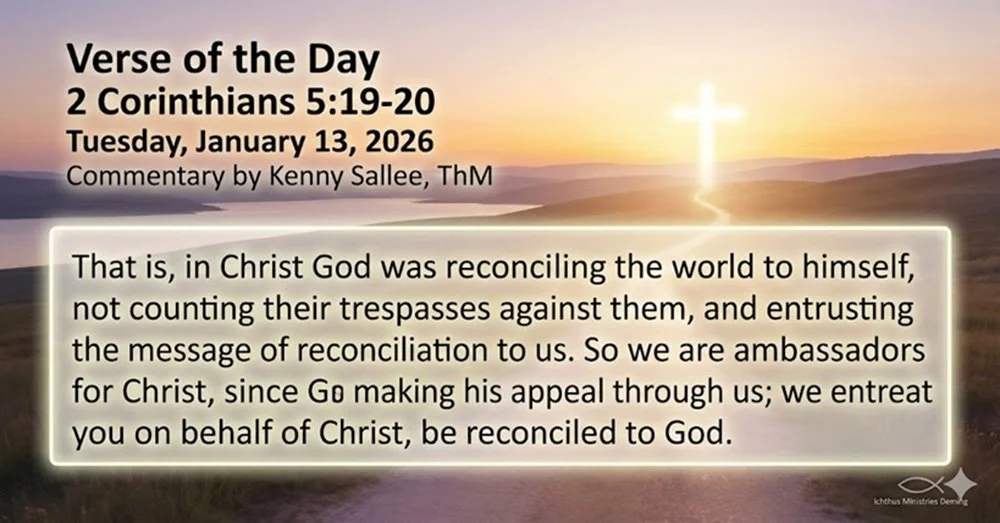
Verse of the Day
Tuesday, January 13, 2026
2 Corinthians 5:19-20
That is, in Christ God was reconciling the world to himself, not counting their trespasses against them, and entrusting the message of reconciliation to us. So we are ambassadors for Christ, since God is making his appeal through us; we entreat you on behalf of Christ, be reconciled to God.
Introduction
At the heart of the Christian faith lies a single, transformative movement: the initiative of God to heal a fractured creation. Second Corinthians 5:19–20 stands as the locus classicus of this doctrine, encapsulating the gospel not as a system of moral improvement, but as a divine rescue mission. The central theme here is reconciliation—the restoration of friendly relations between disparate parties.
This passage is essential for understanding Christian identity because it fundamentally shifts the burden of salvation off of humanity. It clarifies that peace with God is not an achievement of human striving, but a gift of divine grace. Furthermore, it defines the purpose of the Church not merely as a gathering of the saved, but as a deputized body of ambassadors sent into the world. To understand these verses is to understand that the Church exists because God acts, and the Church speaks because God has spoken.
Commentary
Verse 19: "...that is, in Christ God was reconciling the world to himself, not counting their trespasses against them, and entrusting the message of reconciliation to us."
The theological weight of this verse rests on the subject of the action: God. The grammar emphasizes that reconciliation is exclusively God's initiative. The phrase "in Christ God was reconciling the world to himself" locates the mechanism of this peace within the person and work of Jesus. It is not that Christ reconciles God to humanity (as if God needed to be appeased by a third party), but that God, through Christ, removes the barriers separating the world from Himself.
Two specific actions define this reconciliation:
The Non-Imputation of Sin: The text states God is "not counting their trespasses against them." The Greek term for "counting" (logizomenos) is an accounting term meaning to reckon or impute. In the gospel, the ledger of human debt is not merely paid; it is set aside. God refuses to define humanity by its failures.
The Entrusting of the Message: God commits the "message" (or logos) of reconciliation to the apostles and, by extension, the Church. This indicates that the act of reconciliation in history (the Cross) is inextricably linked to the proclamation of that act (preaching).
Verse 20: "So we are ambassadors for Christ, since God is making his appeal through us; we entreat you on behalf of Christ, be reconciled to God."
Paul introduces a powerful political metaphor here: the ambassador (presbeuomen). In the ancient Roman world, an ambassador was a representative sent by a ruler or senate to speak with the full authority of the sender. An ambassador does not speak their own opinions but conveys the message of the sovereign.
This verse reveals the dignity of the Christian calling. When the Church speaks the gospel, it is "God making his appeal through us." The tone, however, is striking. One might expect a sovereign God to command, yet the text says God makes an "appeal" and Paul "entreats" (begs). This highlights the vulnerability of divine love. The Creator does not force reconciliation upon the creature but woos the world through the humble, pleading voices of His servants.
Understanding the Context
To fully grasp the import of these verses, one must appreciate the tension surrounding the letter of 2 Corinthians. This acts as Paul’s most personal and emotional defense of his apostolic authority. He was facing opposition from "super-apostles" who boasted of their rhetorical skill, spiritual experiences, and letters of recommendation. They attacked Paul for his weakness, his suffering, and his lack of polished oratory.
In Chapter 5, Paul re-frames the very nature of ministry. He argues that true apostolic ministry is not about outward impressiveness but about participating in the "new creation" (2 Cor 5:17). He moves from the assurance of the resurrection (5:1–10) to the "fear of the Lord" which compels him to persuade others (5:11).
By the time he reaches verses 19 and 20, Paul is establishing that his ministry—and the ministry of any true servant of God—is valid not because of personal charisma, but because it is authorized by God’s act of reconciliation. The "ministry of reconciliation" (5:18) stands in contrast to a ministry of self-promotion. Paul’s suffering and "weakness" are actually credentials of an ambassador who correctly represents a crucified King.
Application for Today
The metaphor of the ambassador provides a robust framework for Christian ethics in the modern world. If believers are ambassadors, then their citizenship is elsewhere (Philippians 3:20), and they are resident in a "foreign" land—a world often hostile or indifferent to the values of the Kingdom.
1. Representation over Reaction: In an era of polarization and outrage, the ambassadorial model calls for restraint. An ambassador does not engage in petty local squabbles that misrepresent the Sovereign. Christians are called to represent the character of Christ—grace, truth, and mercy—rather than participating in the divisive rhetoric of the age.
2. The Ministry of Peacemaking: The content of the Christian message is reconciliation. This has immediate ethical implications. We cannot herald peace with God while fueling conflict with our neighbors. Whether in family disputes, church disagreements, or social discourse, the believer is obligated to be an agent of de-escalation and restoration.
3. Proclamation: The "message of reconciliation" has been entrusted to us. This is not solely the job of clergy. Every believer carries the dignity of this office. Application today involves the willingness to articulate, with humility, that the solution to the human condition is not found in politics or economics alone, but in being restored to the Creator.
Reflection
Consider the gravity of the title "Ambassador for Christ." It suggests that in your daily interactions—at the grocery store, in the boardroom, or at the dinner table—you are viewed by heaven as an authorized representative of Jesus. This is both a high privilege and a solemn responsibility.
When people encounter you, do they encounter the "appeal" of God? Is the tone of your life one of entreaty and welcome, or judgment and exclusion? It is easy to accept the theological truth that God does not count trespasses against the world; it is much harder to embody that truth by not counting the trespasses of others against us.
To be an ambassador is to allow one's life to become a vehicle for God’s voice. It requires a shedding of the ego and a commitment to the message of the King. As you move forward, examine where in your life you are acting as an independent agent, speaking your own mind, and where you are faithfully delivering the message of reconciliation entrusted to you. The world is waiting not for more opinions, but for the authentic appeal of God’s love, delivered through human vessels.
The Bible texts are from the New Revised Standard Version (NRSV) Bible, copyright © 1989, 1993 the Division of Christian Education of the National Council of the Churches of Christ in the United States of America. Used by permission. All rights reserved. Verse of the Day is a daily inspirational and encouraging Bible verse, extracted from BibleGateway.com. Commentary by Kenny Sallee, ThM.
