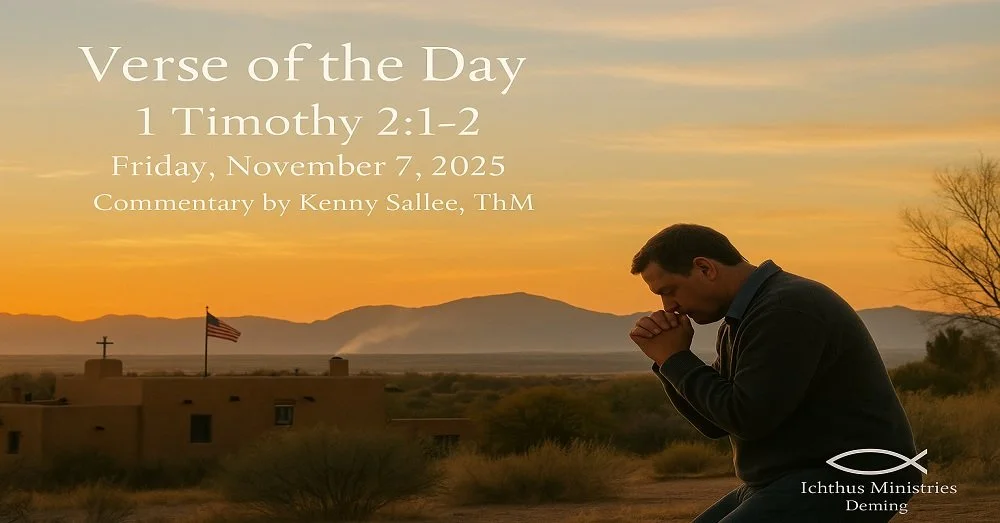
Verse of the Day
Friday, November 7, 2025
1 Timothy 2:1-2
First of all, then, I urge that supplications, prayers, intercessions, and thanksgivings be made for everyone, for kings and all who are in high positions, so that we may lead a quiet and peaceable life in all godliness and dignity.
Introduction
The First Epistle to Timothy is traditionally attributed to the Apostle Paul, written to his younger protégé Timothy, who was serving as a pastoral leader in Ephesus. Its purpose is both instructional and corrective—guiding Timothy in matters of church order, moral conduct, and faithful teaching. In the opening chapter, Paul warns against false doctrines and divisive speculations, setting the stage for this call to communal prayer in chapter two. The verses under consideration emphasize the inclusive and public dimension of Christian intercession. They reveal Paul’s vision for the Church as a body that influences society not through political power, but through piety, prayer, and peaceable conduct.
Commentary
Paul begins with the phrase parakalō oun prōton pantōn (“I urge, therefore, first of all”), underscoring both the urgency and priority of prayer in the life of the Church. The four terms—deēseis (supplications), proseuchas (prayers), enteuxeis (intercessions), and eucharistias (thanksgivings)—reflect a rich and comprehensive theology of prayer.
Supplications (deēseis) denote petitions for specific needs, expressing human dependence upon God.
Prayers (proseuchas) encompass general worshipful communication with God, emphasizing reverence and adoration.
Intercessions (enteuxeis) suggest bold advocacy—standing before God on behalf of others, even those outside the faith community.
Thanksgivings (eucharistias) call believers to gratitude for God’s grace and for the preservation of order and peace in society.
Paul’s insistence that such prayers be made “for everyone” broadens the Church’s horizon beyond its own membership. His inclusion of “kings and all who are in high positions” was radical in a context where political leaders were often indifferent or even hostile to Christians. The goal—“that we may lead a quiet and peaceable life in all godliness and dignity”—reflects not escapism but an aspiration toward social stability that enables spiritual flourishing.
Understanding the Context
In the first century, Christians lived under the rule of the Roman Empire, where emperor worship was intertwined with civic loyalty. To refuse participation in such cultic practices could be construed as subversion or atheism. Paul’s exhortation thus carried a dual purpose: it encouraged believers to pray for those in authority as a demonstration of civic goodwill while maintaining their ultimate allegiance to God alone.
This instruction likely arose from both pastoral and missional concerns. The early church’s survival depended in part on maintaining peace with governing authorities. By promoting prayer for rulers rather than rebellion against them, Paul fostered a posture of humility and moral distinction. The command also affirmed the sovereignty of God over all earthly powers, echoing the prophetic conviction that “the Most High rules the kingdom of men” (Daniel 4:17). In a world where rulers claimed divine sanction, the Christian act of intercession was itself a subtle declaration that true authority belongs to God.
Application for Today
Modern Christians inhabit diverse political and cultural landscapes, yet Paul’s instruction remains strikingly relevant. Prayer for civic leaders—whether we agree with them or not—reflects trust in God’s providence and our responsibility as citizens of both heaven and earth. Interceding for “all who are in high positions” counters the corrosive effects of cynicism, polarization, and resentment. It transforms complaint into compassion and disengagement into participation through prayer.
To live “a quiet and peaceable life in all godliness and dignity” is not to withdraw from public life, but to embody a steady witness of moral integrity, social harmony, and spiritual depth. Christians are called to engage their communities constructively—to vote, to serve, to advocate justice—but always with hearts anchored in prayerful humility. Paul’s counsel reminds believers that peace in the public square often begins with peace cultivated in prayer.
Reflection
Paul’s exhortation in 1 Timothy 2:1–2 presents a timeless vision of faith that bridges the private and public realms. The Church’s strength is not found in political influence but in faithful intercession for all people, including those who hold power. Prayer becomes a moral discipline that softens hostility, enlarges compassion, and aligns believers with God’s redemptive purposes in the world. In turbulent times, the Christian’s quiet strength lies not in outrage or retreat but in steadfast prayer that seeks the common good and honors the dignity of every human being.
The Bible texts are from the New Revised Standard Version (NRSV) Bible, copyright © 1989, 1993 the Division of Christian Education of the National Council of the Churches of Christ in the United States of America. Used by permission. All rights reserved. Verse of the Day is a daily inspirational and encouraging Bible verse, extracted from BibleGateway.com. Commentary by Kenny Sallee, ThM.
