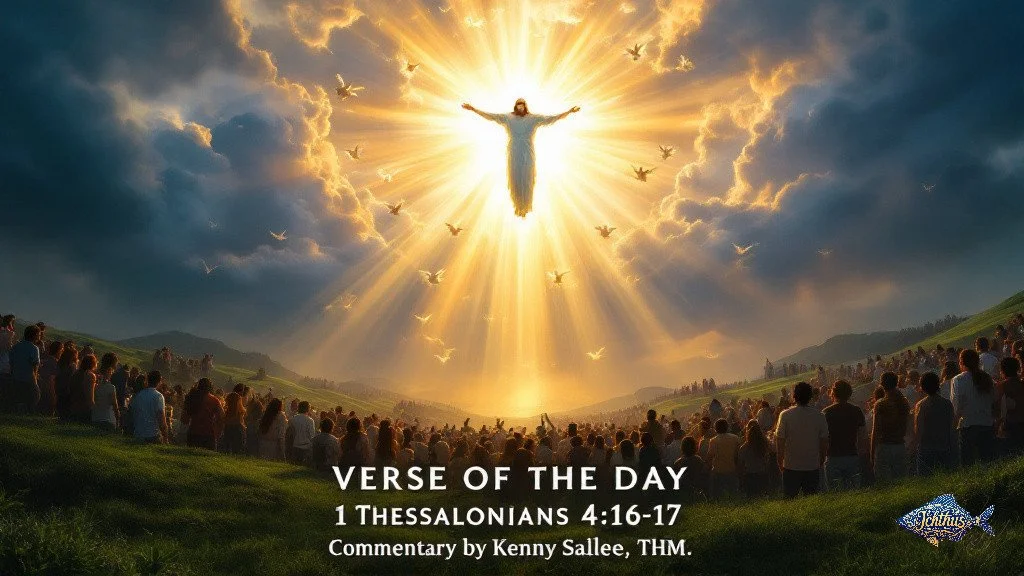
Verse of the Day
Saturday, May 31, 2025
1 Thessalonians 4:16-17
For the Lord himself, with a cry of command, with the archangel’s call and with the sound of God’s trumpet, will descend from heaven, and the dead in Christ will rise first. Then we who are alive, who are left, will be caught up in the clouds together with them to meet the Lord in the air; and so we will be with the Lord forever.
Introduction
This powerful passage from Paul’s first letter to the Thessalonians presents one of the clearest early Christian teachings on the Second Coming of Christ. Paul writes to reassure a grieving church community that the faithful departed will not miss out on Christ’s return, but instead will be the first to rise and be united with Him.
Commentary
Paul lays out a vivid and dramatic sequence:
Christ’s descent is accompanied by three signs: a commanding cry, the archangel’s call, and the trumpet of God—imagery rich with Old Testament echoes (e.g., Exodus 19:16, Zechariah 9:14).
The dead in Christ rise first: This assures believers that those who have died in the faith are not forgotten or disadvantaged.
The living are “caught up” (from the Latin rapiemur, the basis for the term rapture)—they are united with the risen dead and Christ in the air.
Eternal union: The final phrase is one of comfort and promise: “so we will be with the Lord forever.”
Paul emphasizes unity—of the living and the dead, of all believers with Christ. The imagery of being caught up in the clouds is symbolic of divine encounter (cf. Daniel 7:13; Matthew 24:30) and expresses both majesty and mystery.
Understanding the Context
The Thessalonian Christians were deeply concerned about believers who had died before Christ’s return. Many thought the Second Coming was imminent, and they feared that their deceased loved ones would miss out on the kingdom. Paul writes this passage not to provoke speculation, but to comfort and reassure. The letter (written around A.D. 50–51) addresses a young church facing persecution and confusion about eschatological teachings (end times). Paul's pastoral tone seeks to offer clarity and hope.
Application for Today
In an age often dominated by fear—whether of death, loss, or the unknown future—Paul’s words invite believers to trust in God’s promise of resurrection and eternal fellowship with Christ. Rather than focus on when or how the end will come, this passage redirects attention to who will come: the Lord Himself. It teaches us to grieve with hope, to live with expectation, and to comfort one another with the assurance of reunion—not just with each other, but with our risen Lord.
Reflection
Imagine the awe of that moment: the heavens split open, the sound of God’s trumpet echoing across the earth, and every eye turned toward the descending Christ. Death no longer divides us. Time no longer separates us. In that final moment, love triumphs over loss, and life swallows up death. This is not a fantasy—it is our Christian hope. As we walk through our present challenges, Paul’s vision reminds us: our story ends not in despair, but in glory.
The Bible texts are from the New Revised Standard Version (NRSV) Bible, copyright © 1989, 1993 the Division of Christian Education of the National Council of the Churches of Christ in the United States of America. Used by permission. All rights reserved. Verse of the Day is a daily inspirational and encouraging Bible verse extracted from BibleGateway.com. Commentary by Kenny Sallee, ThM.
