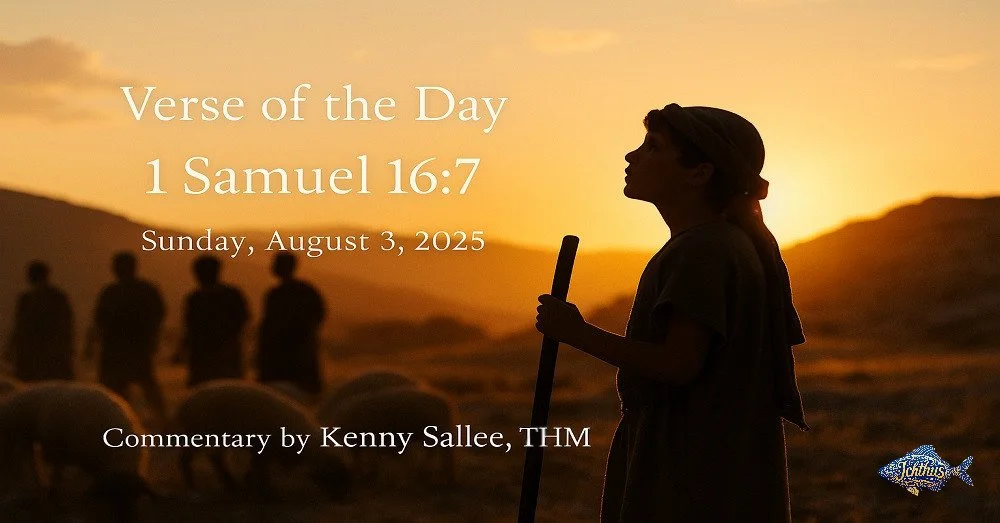
Verse of the Day
Sunday, August 3, 2025
1 Samuel 16:7
But the Lord said to Samuel, “Do not look on his appearance or on the height of his stature, because I have rejected him; for the Lord does not see as mortals see; they look on the outward appearance, but the Lord looks on the heart.”
Introduction
1 Samuel 16:7 stands as a powerful corrective to human assumptions about worth, authority, and leadership. Spoken by God to the prophet Samuel, these words reveal a divine standard that starkly contrasts with human judgment: “Do not look on his appearance or on the height of his stature... for the Lord does not see as mortals see.” In a world where surface-level assessments are common—where charisma, physical presence, and image often determine influence—this passage remains timeless in its relevance.
The verse occurs during a pivotal transition in Israel’s history. King Saul, initially chosen for his impressive stature and outward appeal, has failed to obey God. Now, Samuel is sent to Bethlehem to anoint a new king from among the sons of Jesse. As the prophet surveys Jesse’s sons, he is drawn to the eldest, Eliab—likely because of his commanding appearance. But God intervenes, correcting Samuel’s assumptions and pointing toward a deeper truth: God's chosen servant is not selected based on outward qualities but on the unseen posture of the heart. This sets the stage for the rise of David, Israel’s greatest king.
Commentary
“But the Lord said to Samuel, ‘Do not look on his appearance or on the height of his stature…”
Samuel, even as a seasoned prophet, is susceptible to judging by appearances. “Appearance” (mar’eh) and “height” (gobah) recall the physical traits that once made Saul seem ideal (cf. 1 Sam 9:2). Yet these qualities, impressive to human eyes, are not decisive in God's kingdom.
“…because I have rejected him;”
The term “rejected” (ma’astîw) is strong. Though Eliab had done no wrong, he is not God's choice. This highlights that divine selection is rooted in sovereign will and purpose, not in human credentials.
“…for the Lord does not see as mortals see; they look on the outward appearance, but the Lord looks on the heart.’”
Here, the verb “see” (ra’ah) occurs repeatedly, emphasizing perception. Humans “see” (yir’eh) externally—lammareh—but God “looks” (yir’eh) at the levab or lev, the heart. In Hebrew thought, the heart is the center of will, intellect, and character—not merely emotion. God's gaze penetrates beyond surface to substance.
This phrase establishes a profound theological truth: God evaluates by internal disposition, not external form. It is a rejection of superficiality and an affirmation of authenticity. David, though the youngest and least imposing, is the one whose heart aligns with God's purposes (cf. Acts 13:22).
Understanding the Context
1 Samuel 16 opens in the aftermath of Saul’s disobedience and God’s rejection of him as king (1 Sam 15). Samuel is mourning Saul’s failure when God commissions him to anoint a successor from among Jesse’s sons in Bethlehem. Samuel, understandably cautious, fears Saul’s reprisal should he discover this mission. God provides a cover: a sacrificial visit.
Upon arrival, Samuel is presented with Jesse’s sons. Eliab, the eldest, immediately impresses the prophet. His physical stature no doubt evokes memories of Saul. But God interrupts the pattern, teaching Samuel—and by extension, the reader—that divine priorities differ.
In ancient Israelite culture, leadership was often associated with visible markers: height, birth order, military prowess. The firstborn son typically held prominence. But God overturns this convention by choosing David, the youngest, who is initially left tending sheep.
This turning point initiates the Davidic narrative, one that will shape Israel’s future and ultimately culminate in the Messiah. God’s choice of David, based not on appearance but on heart, anticipates the broader pattern of divine election that privileges the humble, the overlooked, and the faithful.
Application for Today
1 Samuel 16:7 continues to challenge the modern fixation on externals. In an age of image-driven culture—where leadership is often equated with charisma, public speaking skills, or social media presence—this verse calls the Church to recalibrate its vision.
Whether selecting pastors, hiring employees, or simply interacting with neighbors, there is a deep temptation to be swayed by surface impressions. Yet God calls His people to look deeper: at character, humility, spiritual maturity, and integrity.
In church ministry, this passage speaks against celebrity-driven models and affirms the value of unseen faithfulness. In hiring and promotion, it questions whether we prioritize polish over substance. In personal relationships, it reminds us that God's perspective values the heart—the unseen thoughts, motives, and desires.
Equally, this verse speaks to how we evaluate ourselves. Are we cultivating inner lives that are pleasing to God? Are we content to be seen by Him even if overlooked by others? This passage encourages humility, discernment, and the pursuit of a heart shaped by God’s Word and Spirit.
Reflection
The divine rebuke in 1 Samuel 16:7 invites a reordering of values. It disrupts our comfort with easy judgments and calls us to slow down, to look beyond what is visible, and to seek what God sees. In a culture obsessed with the outer shell—appearances, achievements, aesthetics—this verse asks us to reckon with what is hidden: our motivations, our desires, our formation.
What might change in our churches, our workplaces, our homes, if we truly sought to see as God sees? What habits of attention, what disciplines of listening, would we need to cultivate to discern the heart? And how might we live differently if we knew that God's gaze was not fixed on our resumes or our reputations, but on the condition of our souls?
This passage is not just about David’s selection; it is about the ongoing question of vision—who sees rightly, and what truly matters in the eyes of God.
The Bible texts are from the New Revised Standard Version (NRSV) Bible, copyright © 1989, 1993 the Division of Christian Education of the National Council of the Churches of Christ in the United States of America. Used by permission. All rights reserved. Verse of the Day is a daily inspirational and encouraging Bible verse, extracted from BibleGateway.com. Commentary by Kenny Sallee, ThM.
