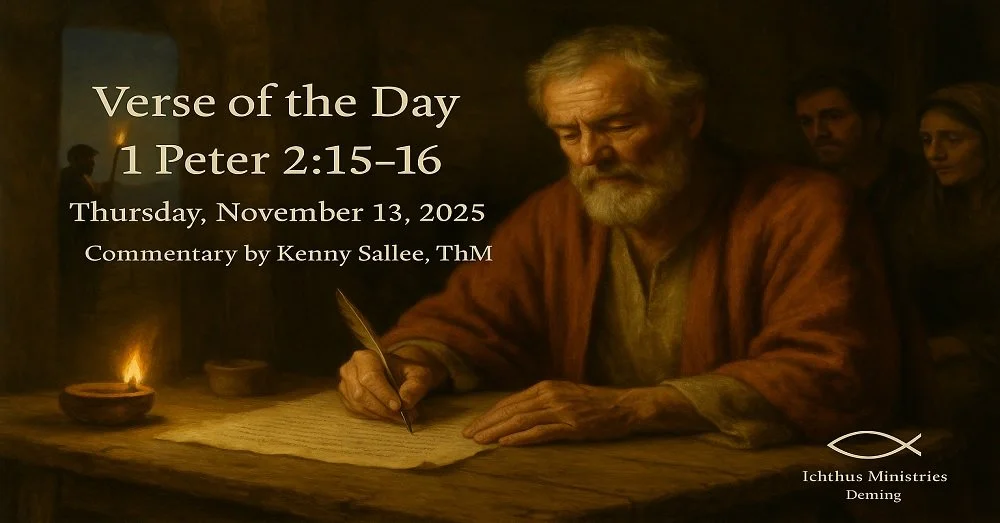
Verse of the Day
Thursday, November 13, 2025
1 Peter 2:15-16
For it is God’s will that by doing right you should silence the ignorance of the foolish. As servants of God, live as free people, yet do not use your freedom as a pretext for evil.
Introduction
In his first epistle, the Apostle Peter addresses a dispersed and suffering Christian community, encouraging them to live honorably in a world often hostile to their faith. In 1 Peter 2:15–16, he articulates a profound theological paradox: believers are both free in Christ and servants of God. This freedom, however, is not license for rebellion or self-serving behavior; rather, it is a divine calling to exemplify righteousness in a way that silences ignorance and bears witness to the transforming power of God’s grace. Within the broader argument of 1 Peter, these verses form part of Peter’s teaching on submission to authority and the Christian witness in public life—demonstrating how faith, freedom, and obedience to God coexist harmoniously under divine sovereignty.
Commentary
Verse 15: “For it is God’s will that by doing right you should silence the ignorance of the foolish.”
The Greek phrase “to agathopoiountas” (τοὺς ἀγαθοποιοῦντας), translated “doing right” or “doing good,” conveys more than moral correctness; it implies active benevolence and visible goodness. Peter insists that righteous conduct—especially under unjust conditions—serves as the believer’s defense and testimony. The term “ignorance” (agnoia) does not imply mere lack of information but willful misunderstanding born of prejudice or hostility toward the Christian faith. Peter’s argument reflects the belief that Christian virtue, when lived consistently, has the power to disarm slander and refute false accusations without the need for verbal confrontation. God’s will (thelēma tou Theou) is thus manifested not in argumentation but in embodied goodness.
Verse 16: “As servants of God, live as free people, yet do not use your freedom as a pretext for evil.”
The tension between freedom (eleutheria) and servanthood (douloi tou Theou) defines the heart of Peter’s theology of Christian ethics. Freedom in Christ liberates believers from sin, fear, and spiritual bondage, but not from moral responsibility or social obligation. The phrase “as free people” (hōs eleutheroi) affirms the believer’s dignity before God, yet Peter quickly qualifies it: freedom must not become a “pretext for evil” (epikalymma tēs kakias), literally a “covering” or disguise for wrongdoing. The apostle thus warns against using Christian liberty as justification for lawlessness or defiance. Instead, true freedom is found in willing service to God, a paradox that lies at the core of Christian discipleship—liberation through submission.
Understanding the Context
Peter wrote to Christians scattered throughout Asia Minor during a time of growing suspicion toward the early Church. Followers of Jesus were viewed as social outsiders—refusing to participate in pagan rituals, imperial cults, and civic celebrations. Their separation was often misconstrued as political rebellion or moral deviance. Against this backdrop, Peter instructs believers to live honorably among the Gentiles (1 Peter 2:12) so that their good works would refute slanderous accusations. The call to “submit to every human institution” (2:13) was not a capitulation to imperial ideology but a strategic expression of faith—demonstrating that Christian allegiance to God does not negate social order but redeems it through righteousness.
In the Roman world, freedom was often associated with social status and personal autonomy, reserved primarily for the elite. Peter’s redefinition of freedom as spiritual servanthood was therefore revolutionary. Christians, though marginalized, were reminded that their true identity and freedom came from God, not from earthly powers. This teaching helped early believers navigate persecution without resorting to hostility or withdrawal, affirming that moral integrity within an unjust system could still glorify God.
Application for Today
In modern society, where freedom is often equated with self-determination or the absence of restraint, Peter’s message remains profoundly relevant. Christian freedom is not the right to do whatever one pleases but the capacity to do what is right in service to God and others. In civic life, this means engaging responsibly—upholding justice, respecting legitimate authority, and acting with integrity even when misunderstood or opposed.
In workplaces, communities, and digital spaces, believers are called to “silence ignorance” not through argument or outrage but through consistent goodness, humility, and truthfulness. Freedom in Christ empowers ethical action, compassion, and advocacy for the vulnerable. It challenges Christians to use their liberties not for self-promotion but for service, reconciliation, and witness. Peter’s teaching reminds us that genuine Christian influence flows not from dominance but from faithful obedience, moral clarity, and self-giving love.
Reflection
The paradox of being both “free” and “servants of God” defines the Christian life in every generation. Freedom in Christ releases us from sin’s tyranny and fear’s bondage, yet it binds us joyfully to the will of God. The mature believer recognizes that spiritual liberty is not found in self-assertion but in surrender—the kind of surrender that turns freedom into service and service into love. In a culture that often prizes independence above all, Peter’s words call us to rediscover a deeper form of freedom: one that reflects the image of Christ, who, though Lord of all, became the servant of all. When believers live this way—doing good, loving truth, and serving God above self—they reveal a freedom that no power on earth can silence.
The Bible texts are from the New Revised Standard Version (NRSV) Bible, copyright © 1989, 1993 the Division of Christian Education of the National Council of the Churches of Christ in the United States of America. Used by permission. All rights reserved. Verse of the Day is a daily inspirational and encouraging Bible verse, extracted from BibleGateway.com. Commentary by Kenny Sallee, ThM.
