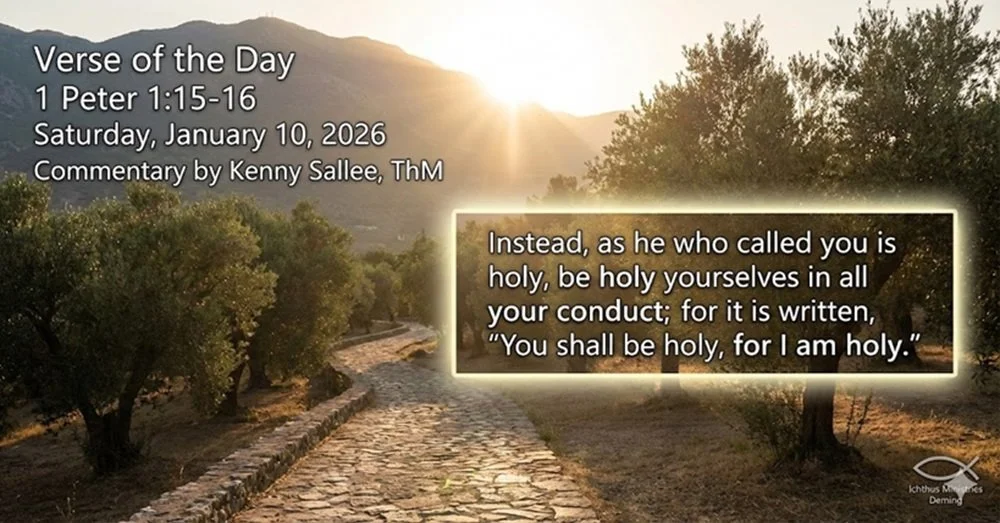
Verse of the Day
Saturday, January 10, 2026
1 Peter 1:15-16
Instead, as he who called you is holy, be holy yourselves in all your conduct; for it is written, “You shall be holy, for I am holy.”
Introduction
The command to "be holy" often evokes feelings of inadequacy or fear of rigid moralism. For many believers, holiness is associated with an impossible standard of perfection or a list of prohibited behaviors. However, in 1 Peter 1:15–16, the Apostle Peter reframes holiness not merely as a moral duty, but as an ontological reality rooted in the very nature of God. This passage serves as a foundational pillar for Christian ethics, bridging the ancient identity of Israel with the new reality of the Church. It challenges the reader to understand that their behavior (conduct) is inextricably linked to their identity as children of the One who called them.
Commentary
"Instead, as he who called you is holy..."
The initiative begins with God. Peter identifies God primarily as the "caller." This calling is effective and transformational, pulling the believer out of their former "ignorance" and "passions" (v. 14) into a new sphere of existence. The standard for this new life is God’s own character.
"...be holy yourselves in all your conduct..."
The Greek word for holy is hagios, implying being "set apart" or "distinct" from the common or profane. It does not imply withdrawal from the world, but a distinct quality of existence within it. The word for "conduct" (anastrophē) refers to one's way of life, social behavior, and daily interaction. Peter is emphatic that holiness is not a compartmentalized religious activity; it permeates "all" conduct—public, private, sacred, and secular.
"...for it is written, 'You shall be holy, for I am holy.'"
Peter grounds his instruction in the Torah, specifically quoting Leviticus (11:44; 19:2; 20:7). By applying this Levitical mandate to the Christian community, Peter asserts that the Church now inherits the vocation of Israel: to be a visible representation of God's character to the nations. The motivation is relational (imitation of the Father) rather than merely legal.
Understanding the Context
First Peter is a "circular letter" addressed to the "exiles of the Dispersion" in Asia Minor—Christians living as a marginalized minority in a dominant pagan culture. These believers faced social ostracism, slander, and suffering for their faith.
In this context, the call to holiness was a survival mechanism for their identity. If they assimilated completely into the surrounding culture, they would lose their distinctiveness; if they withdrew completely, they could not witness to the nations. Peter calls them to a third way: living as "resident aliens" who maintain a distinct ethical lifestyle that reflects God. This holiness was intended to be missional—a way of life so striking that it would provoke questions and ultimately glorify God (1 Peter 2:12).
Application for Today
In the contemporary world, the pressure to conform to cultural norms is subtle but intense. We are often tempted to bifurcate our lives: acting one way in church and another in the workplace or political sphere. 1 Peter 1:15–16 challenges this fragmentation.
Holiness as Wholeness: We must recover the idea that holiness means integrity—being the same person in all situations.
Distinctiveness: Application requires asking, "In what way is my business ethic, my language, or my treatment of enemies distinct from the prevailing culture?"
Reflection of Character: We are not called to follow a rulebook for the sake of rules, but to reflect a family resemblance. Just as children often pick up the mannerisms of their parents, our conduct should naturally reflect the God who called us.
Reflection
The command to be holy is less about achieving a status and more about maintaining a trajectory. It asks us to consider the source of our actions. If we view holiness only as a burden, we miss the profound dignity Peter assigns to us: that finite, broken humans are capable of reflecting the infinite character of God. The tension of this passage lies in the gap between our current conduct and God’s perfect nature. However, it is within that tension that spiritual growth occurs. We are called to be living mirrors, however imperfect, angled in such a way that our daily lives catch the light of God’s holiness and reflect it into the darkened corners of our world.
The Bible texts are from the New Revised Standard Version (NRSV) Bible, copyright © 1989, 1993 the Division of Christian Education of the National Council of the Churches of Christ in the United States of America. Used by permission. All rights reserved. Verse of the Day is a daily inspirational and encouraging Bible verse, extracted from BibleGateway.com. Commentary by Kenny Sallee, ThM.
