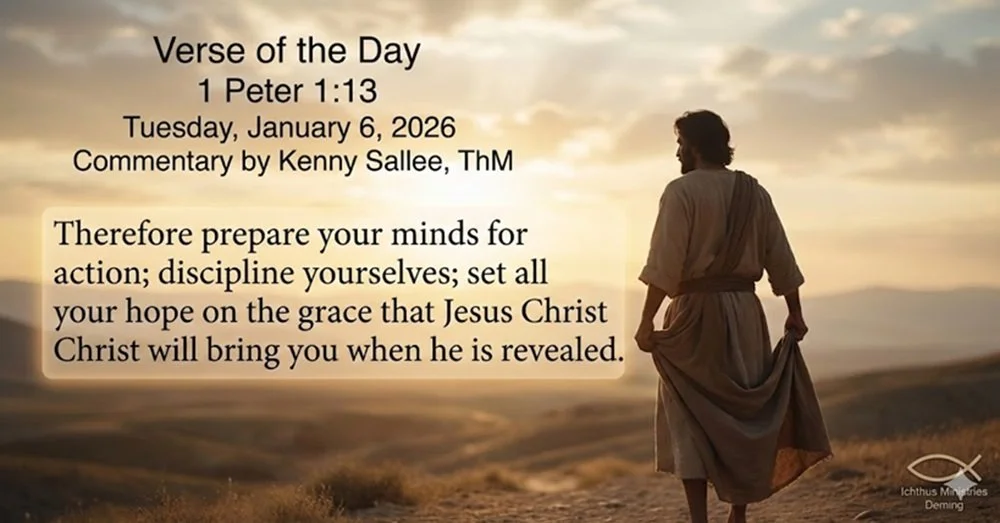
Verse of the Day
Tuesday, January 6, 2026
1 Peter 1:13
Therefore prepare your minds for action; discipline yourselves; set all your hope on the grace that Jesus Christ will bring you when he is revealed.
Introduction
First Peter 1:13 marks a critical pivot point in the epistle. In the preceding verses (1:3–12), Peter offers a soaring theological preamble, describing the "living hope" and the imperishable inheritance reserved for believers. Verse 13 begins with the word "Therefore," signaling a shift from indicative (what God has done) to imperative (what believers must do).
This verse serves as the gateway to the letter’s ethical instructions. It is a call to mental and spiritual combat readiness. Peter is telling his audience that theology is not meant to be merely admired, but acted upon. The grand truths of salvation require a specific posture of life characterized by alertness, self-control, and singular focus.
Understanding the Context
To fully grasp the weight of this verse, we must understand the cultural metaphors and the specific situation of the original audience.
The "Girding" Metaphor: The NRSVCE phrase "prepare your minds for action" translates the literal Greek idiom: "gird up the loins of your mind." In the ancient Near East, men and women wore long, flowing tunics that hindered running, fighting, or hard labor. To prepare for intense physical activity, one would gather the loose fabric, pull it between the legs, and tuck it into a belt (girdle).
This action transformed a garment of rest into a garment of readiness. By applying this physical metaphor to the "mind," Peter is commanding believers to gather up loose, distracted thoughts and secure them with truth, preparing for the spiritual exertion of living as Christians in a hostile environment.
The Audience — "Resident Aliens": Peter addresses his letter to "exiles of the Dispersion" (1 Peter 1:1). These were Christians living in Asia Minor (modern Turkey) who were facing social ostracism, slander, and perhaps local persecution because they no longer participated in the pagan religious and social rituals of their neighbors. They were "resident aliens"—living in the world but distinct from it. Verse 13 provides the survival strategy for this specific tension: they must be mentally sharp to withstand social pressure.
Commentary
This single verse contains three distinct but related commands that form a triad of Christian readiness.
A. "Prepare your minds for action": This is the call to mental vigilance. Peter implies that a loose, unguarded mind is dangerous for a Christian. Just as a soldier cannot fight with a tunic tangling his legs, a believer cannot stand firm in faith if their mind is cluttered with worry, fear, or worldly distractions. It suggests a decisive break from mental passivity. The Christian life requires intentional cognitive effort to align one's thinking with the reality of the gospel.
B. "Discipline yourselves": Older translations often render this as "be sober." While it can refer to literal sobriety (abstaining from drunkenness), in the New Testament, it more often refers to spiritual and emotional stability. It is the opposite of being intoxicated by the emotions of the moment or the allure of the surrounding culture. To "discipline yourself" is to maintain a balanced perspective, seeing things as God sees them, rather than being swept away by the panic or passions of the age.
C. "Set all your hope on the grace...": This is the climax of the verse. The command is to hope "fully" (perfectly or completely) on the grace that is coming. This is an eschatological command—it looks to the future.
The Object of Hope: It is not a generic optimism that "things will get better," but a specific reliance on the grace that will be revealed at the Parousia (the second coming of Christ).
The Nature of Hope: Peter demands an undivided hope. He warns against hedging one's bets—placing some hope in Christ and some in financial security, social status, or political power.
Application for Today
The instructions of 1 Peter 1:13 are remarkably relevant to the modern context, characterized by information overload and cultural anxiety.
Combatting Distraction: In an age of endless scrolling and 24-hour news cycles, our minds are rarely "girded." We often suffer from mental "loose fabric"—fragmented attention spans and anxiety loops. This verse challenges us to curate our mental intake, intentionally filtering out noise that hinders our spiritual walk.
Emotional Sobriety: We live in a culture that monetizes outrage and fear. To "discipline ourselves" today means refusing to be intoxicated by the collective anger or panic of society. It calls for a calm, steady presence that comes from a mind fixed on Christ rather than the crisis of the day.
Future-Oriented Living: It is tempting to place our hope in immediate relief or temporary solutions. Peter calls us to "long-term" hope. When we face difficulties, the application is not to despair, but to anchor our stability in the ultimate resolution of history: the return of Jesus. This perspective prevents us from being crushed by present troubles.
Reflection
There is a profound realism in Peter’s exhortation. He does not promise that the "exiles" will suddenly be accepted by the culture, nor does he promise an end to their suffering in the immediate sense. Instead, he empowers them to change their internal posture.
The image of the "girded mind" suggests that holiness is not an accident; it is a strategy. We do not drift into spiritual maturity; we must prepare for it. The transition from the "living hope" of verse 3 to the "disciplined mind" of verse 13 teaches us that high theology must result in deep tenacity. To live effectively as a Christian requires a intellect that is tied up tight against the tripping hazards of the world, and a heart that is completely tethered to the future grace of God.
The Bible texts are from the New Revised Standard Version (NRSV) Bible, copyright © 1989, 1993 the Division of Christian Education of the National Council of the Churches of Christ in the United States of America. Used by permission. All rights reserved. Verse of the Day is a daily inspirational and encouraging Bible verse, extracted from BibleGateway.com. Commentary by Kenny Sallee, ThM.
